
No products in the cart.
Christmas Gifts
Why Is Christmas on December 25? A Short History of the Holiday
07
Oct
Oct
Anyone asking why is christmas on 25th december usually expects a single answer, but the evidence points to a layered one. December 25 became the traditional feast day for the birth of Jesus in the early centuries of the Church, and no surviving source proves it was his actual birth date. The Gospels give no day or month, so the choice rests on early Christian reasoning, Roman calendar context and gradual custom.
This guide separates documented history from scholarly theory and modern practice. It covers the main explanations, the January 7 calendar gap, customs from around the world and the way families in the United States celebrate today, without presenting any one theory as settled.
Historical Theories Behind the December 25 Date
Early Christian Chronology
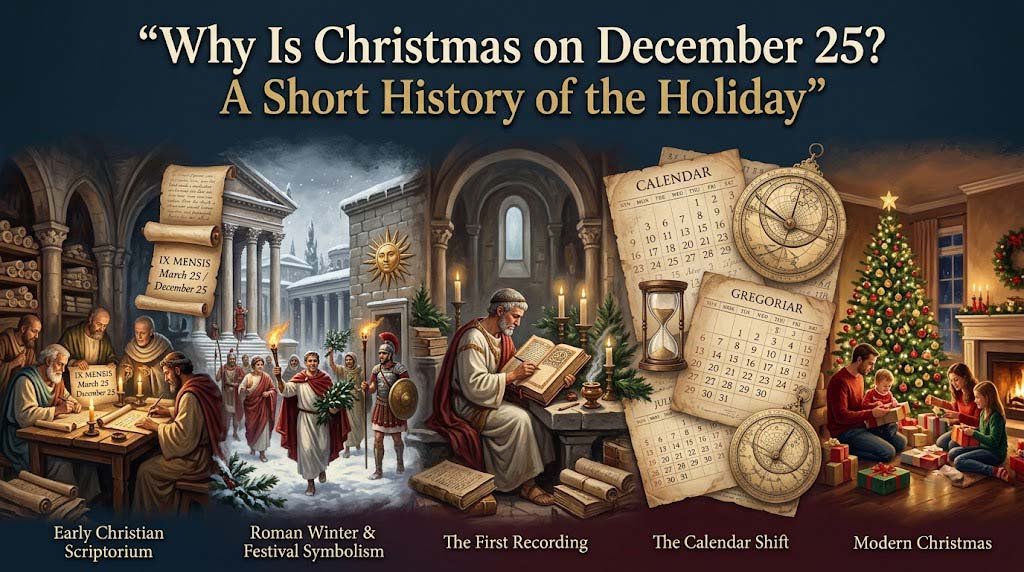
Some early Christian writers, as early as the third century, linked the conception of Jesus to March 25, a date later tied to the Annunciation in church tradition. Counting nine months forward from that day leads directly to December 25.
This reasoning was symbolic and theological rather than a record of an observed birth. It shows how early Christians used calendar logic to place sacred events, and many historians treat it as a strong candidate explanation.
Roman Winter Festivals and Public Culture
Late December was crowded with Roman celebrations. Saturnalia, a festival of feasting and gift-giving, took place earlier in the month, and by the fourth century December 25 was associated with the birthday of the Unconquered Sun, known as Sol Invictus.
Some scholars argue that church leaders chose the date to offer a Christian alternative to these festivals. Others point out that overlapping timing does not prove direct borrowing, and that the calculation theory can stand on its own.
Why Historians Avoid a Single-Cause Answer
The two explanations are often presented as rivals, yet they may have reinforced each other. The surviving evidence is thin, and many of the sources that connect the date to a specific cause are later commentary rather than contemporary records.
A careful summary is that December 25 is a feast date with several plausible origins. It is not independent evidence of a birth date, and no single theory commands universal agreement.
The Earliest Records of Christmas on December 25
The First Recorded Observance
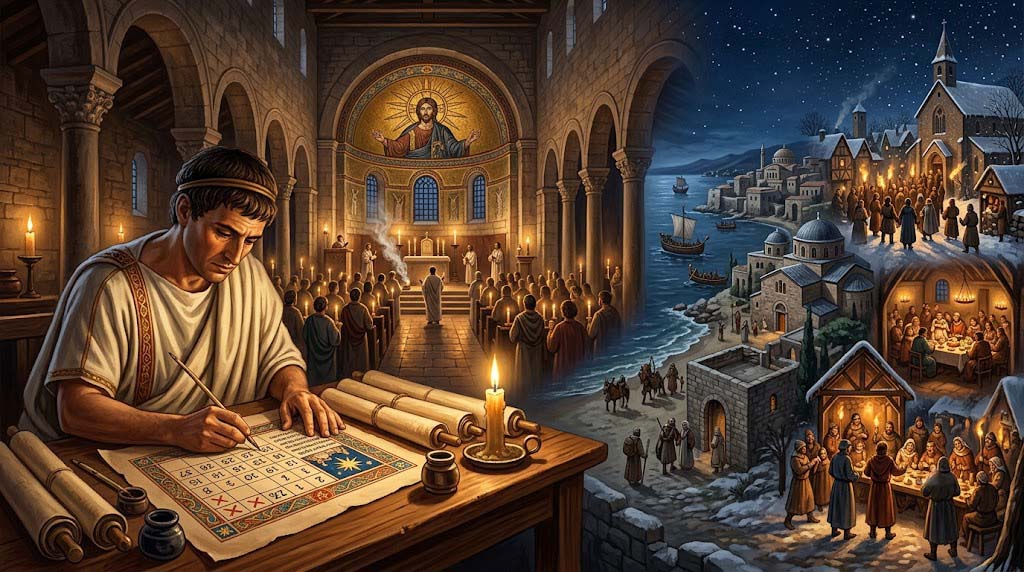
A Roman calendar compiled in the year 354 lists the birth of Christ on December 25, and the entry is generally understood to reflect an observance in Rome that is often dated to 336 AD, during the reign of Emperor Constantine. That is the earliest widely cited evidence for the date.
The same document also marks a festival of the Unconquered Sun on that day. This overlap is one reason the question of influence remains debated rather than resolved.
A Slow and Uneven Spread
Communities did not adopt the date at the same moment. In the eastern Mediterranean, January 6 held a major feast connected to the manifestation of Jesus, and the December 25 observance reached many regions gradually over the following decades.
By the Middle Ages, Christmas was a major feast across Europe. Rulers were crowned on the day, including Charlemagne in the year 800, which helped establish its public importance.
From Feast Day to Holiday Season
Over time, the single feast grew into a season of church services, communal meals, carols and plays. The twelve days that follow Christmas became a period of celebration in many parts of Europe.
The strong emphasis on home, children and gift exchange developed much later, mainly in the nineteenth century. That shift explains why the modern holiday looks so different from its early form.
Why Some Christians Celebrate on January 7
Julian and Gregorian Calendars in Plain Terms
The Julian calendar, introduced under Julius Caesar, slightly overestimated the length of the year, so its dates slowly drifted from the seasons. Pope Gregory XIII introduced a corrected version in 1582, and most of the world now uses it.
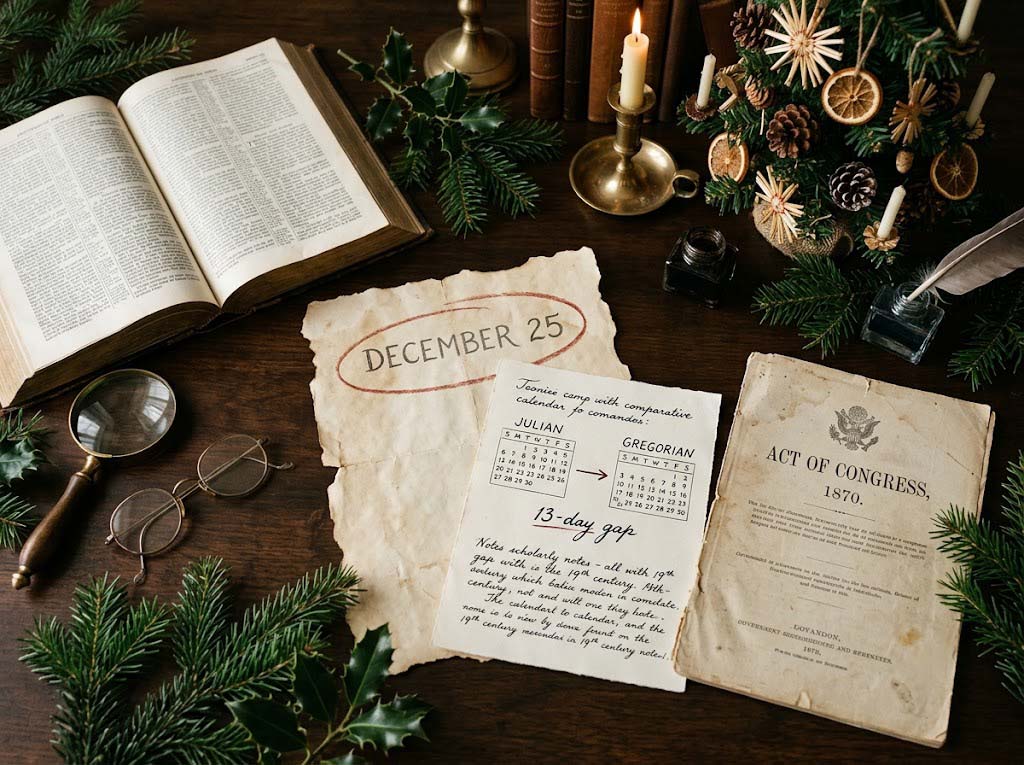
Because the older calendar kept running in some church communities, the two systems have moved apart. In the current century the gap is 13 days.
The Same Date, Counted Differently
December 25 on the Julian calendar currently falls on January 7 on the Gregorian calendar. Churches that observe Christmas on January 7 are therefore keeping the same feast day, counted with a different calendar.
This is a matter of calendar use and not of a different date for the holiday itself. Secular dates in those countries still follow the Gregorian calendar.
No Single Orthodox Practice
Orthodox communities do not all follow one pattern. Several Orthodox churches use a revised calendar and celebrate on December 25, while others, including the Russian and Serbian churches, keep the Julian dates for the feast.
Local custom, liturgy and church governance all play a role. The label “Orthodox Christmas” is best understood as a family of related practices.
European Roots of Familiar Christmas Customs
The Yule Log and Midwinter Feasts
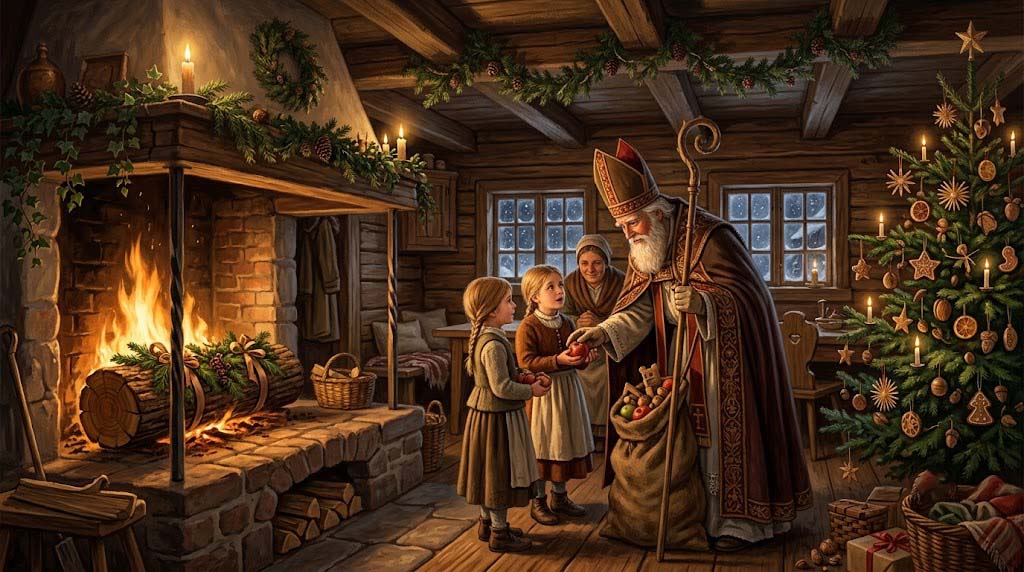
Yule was a midwinter festival in parts of Germanic and Nordic Europe, and the word is still used for Christmas in some contexts. The custom of burning a large log through the festive season is traditionally linked to those northern winter celebrations.
Historians caution that many details of early Yule practice are poorly documented. Later writers often described the customs more confidently than the sources allow.
The Christmas Tree
Evergreen branches were used as winter decoration in many cultures long before Christmas trees. Decorated trees appear in written records from German-speaking regions in the 1500s, and the custom spread widely across Britain and North America in the nineteenth century.
Printed images of royal family trees in the 1840s helped make the tree fashionable. By the late 1800s it had become a standard part of the holiday in many homes.
St. Nicholas and Gift-Giving
Nicholas was a fourth-century bishop of Myra, in present-day Turkey, remembered for generosity toward the poor. His feast day, December 6, became associated with gifts for children in several European countries.
Dutch immigrants carried the figure of Sinterklaas to North America, where the name and image gradually evolved into Santa Claus.
Christmas Traditions Around the World
Fried Chicken in Japan
Christmas is not a widely religious holiday in Japan, yet it has a distinctive food custom. Since the 1970s, a fast-food marketing campaign has helped make fried chicken a Christmas meal for many families, and orders are often placed well in advance.
The example shows how a holiday can take on local meaning, even when its original religious context is not part of everyday celebration.
Lanterns and Radishes
Two regional festivals show how craft and community shape the season:
- In San Fernando in the Philippines, a Giant Lantern Festival in December features large, elaborate lanterns with patterned lights.
- In Oaxaca, Mexico, the Night of the Radishes on December 23 displays scenes carved from large radishes.
Both events are community showpieces. They are built around local skill and shared effort, not around a single religious ritual.
Which Day Matters Most
The central moment of Christmas differs by country. In Germany, Poland and many Nordic countries, the main meal and gifts traditionally come on Christmas Eve, and Spanish-speaking regions often emphasize Nochebuena, the same evening.
In Spain, gifts are also traditionally given on January 6, the day of the Three Kings. These variations are different ways of marking the same season, not competing versions of it.
Modern US Christmas: From History to Family Rituals
A Blend of Cultures in America
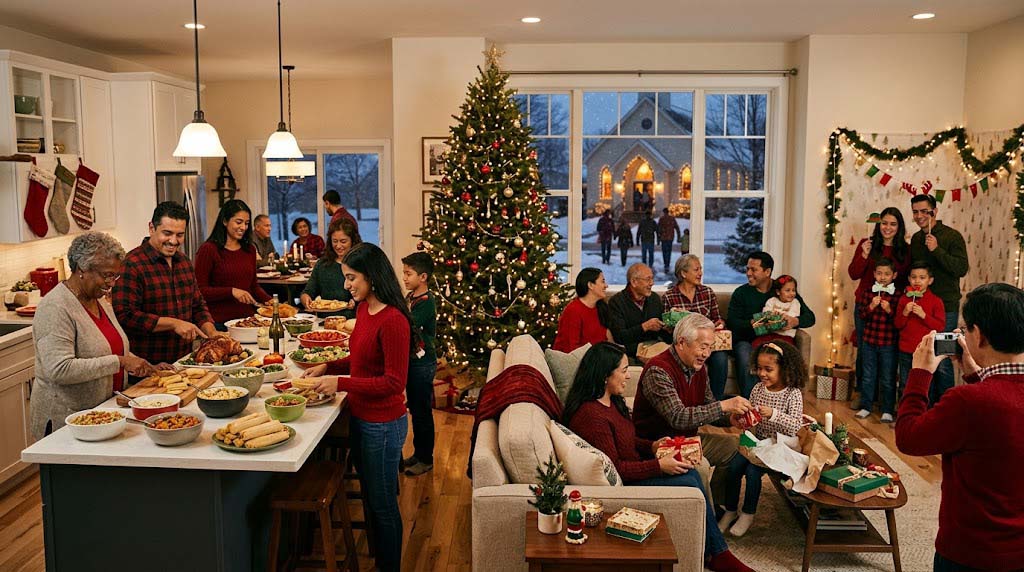
American Christmas customs combine traditions from many groups, including German, Dutch, British, Irish and Latin American communities. Observance was uneven in the early colonial period, and the holiday gradually became a widely shared celebration over the nineteenth century. For a closer look at everyday customs, see this overview of christmas traditions in america.
Today the holiday blends worship, family meals, decorations, gifts, music and seasonal media. For many households these elements sit side by side without conflict.
Modern Family Traditions
Alongside church services and shared meals, many families have added newer rituals. A holiday card photo, a morning gift opening or coordinating family christmas outfits for pictures has become a familiar way to mark the day.
These customs are recent, but they follow the same pattern as older ones. They give relatives a shared activity and create memories that families repeat year after year.
Differences Across Regions and Households
Christmas can look very different across the country. Climate, faith community, family background and work schedules all influence whether the day centers on worship, travel, a large meal or a quiet morning at home.
No single version is the standard. Recognizing that variety makes it easier to welcome guests and relatives whose traditions differ.
Looking Ahead: Planning for the Holiday Season
Preparing for December 25
Understanding where the date comes from can make the season more meaningful, and it also helps with practical planning. In 2026, December 25 falls on a Friday, which creates a long weekend for many households.
Readers who want to organize travel, shopping and gatherings can check how many days until christmas and build a simple timeline from there. Starting early leaves room for the unexpected.
Keeping the History Part of the Tradition
Families can turn history into a conversation by asking older relatives where a custom came from. Writing down a recipe, a song or a story keeps the origin visible for the next generation.
Introducing one custom from another country, such as a new dish or a Christmas Eve meal, is an easy way to learn about the wider holiday. Explain it accurately and respectfully, and avoid ranking one tradition above another.
Christmas History FAQ
Does the Bible state Jesus was born on December 25?
No. The Gospels describe the birth but do not give a day or month. December 25 comes from later church tradition and calendar reasoning, so it is best understood as a feast date rather than a documented birthday.
Why is it called Christmas?
The word comes from the Old English phrase Cristes mæsse, meaning Christ’s Mass, a church service held to mark the feast. Over the centuries the phrase was shortened into the form used today.
Are Christmas trees originally a pagan tradition?
Evergreen branches were used in winter celebrations in many cultures, but historians disagree about how directly the decorated tree descends from pre-Christian practice. The earliest well-documented Christmas trees come from German-speaking regions in the 1500s.
Why do some countries open gifts on December 24?
In several countries, including Germany and Poland, the main family gathering takes place on Christmas Eve. In some church traditions a feast day begins the evening before, and the Christmas Eve meal grew into the central event of the celebration.
When did Christmas become a US federal holiday?
Congress made December 25 a federal holiday in 1870, initially covering federal employees in the District of Columbia. Observance had been uneven earlier, and some colonial communities discouraged it, so the holiday became widespread only gradually.