
No products in the cart.

Halloween Gifts
Top Rated Halloween Animatronics 2026: The Ultimate Buying Guide

26
Sep
Sep
An animatronic can be the single best investment in a Halloween display or the one prop that breaks by the second week of October, and the difference usually comes down to details that aren’t obvious from a product photo — how it activates, what it’s actually rated for outdoors, and how much space it needs once it’s lunging or spinning. This guide breaks down Halloween animatronics by trend, budget, movement, and setup, so you know what you’re actually buying before it’s staked into the yard.
Top Halloween Animatronics Trends for 2026
The rise of oversized yard figures
Figures in the 10- to 12-foot range have become one of the most talked-about categories in yard decor, largely because scale alone creates an impact that a smaller prop simply can’t match from down the street. The tradeoff is real estate — a figure this size needs a stable, open footprint and a storage plan for the eleven months it isn’t standing in the yard.
Buying early matters more for this category than almost any other on this list, since production and freight time for something this large means popular designs can sell out or face shipping delays weeks before Halloween itself even arrives. Pro Tip: Checking your how many days is it halloween countdown against a specific listing’s delivery estimate is highly recommended before committing to an oversized figure.
Licensed horror movie characters
Animatronics built around recognizable horror movie characters remain popular for haunted-house-style displays, since visitors already have a built-in emotional reaction to the design. Anything using a licensed character is worth double-checking for authenticity and seller legitimacy, since counterfeit versions of popular licensed props are common during peak season.
It’s worth reading the product description closely, too — some listings market a figure as “inspired by” a well-known character rather than using an actual licensed likeness, which affects both the price and how closely the final product matches what you’re picturing.
Hyper-realistic and silicone-faced animatronics
At the higher end of the market, figures with silicone skin and more detailed facial movement aim for a genuinely unsettling realism rather than a cartoonish scare. The added detail in expression and texture is what sets this category apart — it’s built to hold up to close-up scrutiny in a way a painted plastic face never quite manages.
This realism comes at a price, both literally and in terms of upkeep — expect a higher cost than a standard plastic-faced figure, along with the extra storage care covered later in this guide.
Setting Expectations: What Your Budget Actually Buys
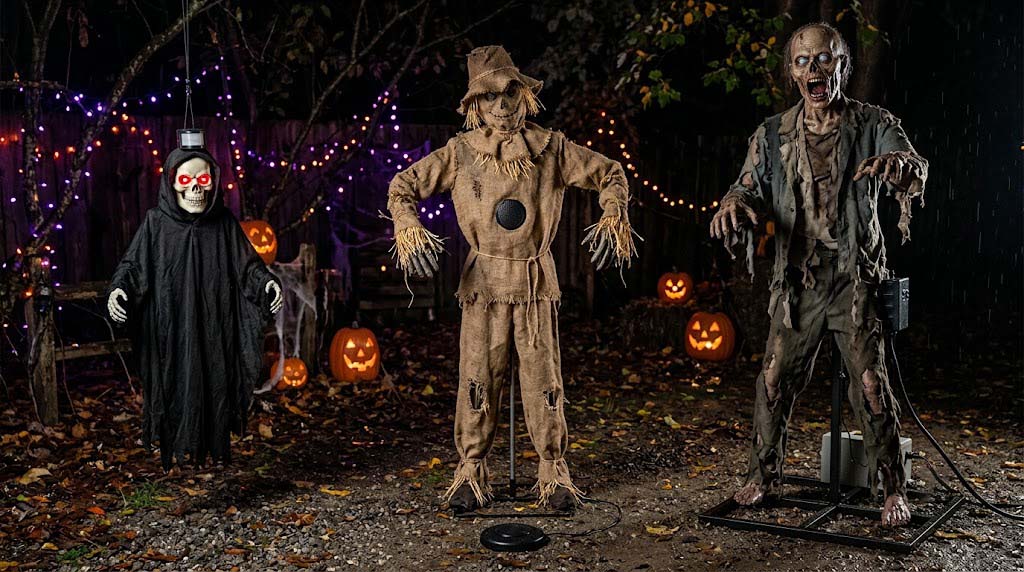
Entry-level: basic motion and sound
At the lower end of the market, figures are typically smaller — tabletop, hanging, or half-body designs — with a simple sensor and thinner plastic construction. These work well for a first-time buyer or a small display, though the movement and sound tend to be limited to one or two repeated actions rather than a full sequence.
The tradeoff mostly shows up in longevity — thinner plastic joints and simpler motors are more likely to wear out or crack after a couple of seasons of setup and teardown than the sturdier hardware used further up the price range.
Mid-range: full-size figures and step pads
This tier generally introduces full-height figures in the 5- to 6-foot range, built on a lighter steel frame with head and arm movement, and often includes a step pad input alongside the standard motion sensor. It’s usually the sweet spot for someone who wants a genuine centerpiece without committing to premium pricing or oversized storage.
Assembly at this tier usually takes longer too — expect to spend a genuine chunk of an afternoon connecting limbs, running cables, and testing the sensor before the figure is actually display-ready.
Premium: multi-axis movement and weatherproofing
At the top of the market, servo-driven multi-axis movement — eyes, mouth, and body all moving somewhat independently — combines with a sturdier metal frame and a finish built to hold up better against weather. This is also where the price climbs fastest, so it’s worth confirming the specific movement and materials rather than assuming “premium” automatically means every feature is included.
Given the price jump, it’s worth checking the specific return and warranty terms before buying — a defect or shipping-damage issue on an oversized premium figure is a much bigger loss than the same problem on a $100 model.
Evaluating Movement, Sound, and Activation Controls
Jump-scare lunging versus continuous ambient motion
A figure that lunges or lurches suddenly needs real clearance in front of it — both for the mechanism itself and for whoever it’s startling — while a figure with continuous, ambient motion (a slow head turn, a subtle sway) works fine in a tighter space since nothing moves toward the visitor. Deciding which effect you actually want changes both the placement and the amount of open ground the figure needs.
It’s also worth considering how the two interact with sound — a lunging motion paired with a loud, sudden noise creates a much stronger effect than either element alone, while continuous ambient motion tends to pair better with a quieter, looping soundtrack.
Choosing the right trigger: motion sensors versus step pads
Motion sensors trigger from a distance, which makes them convenient for a walkway or entry point, but they’re also more prone to false activation from wind, passing cars, or a neighbor’s dog. Step pads require someone to physically step in a specific spot, which gives you more precise control over exactly when the scare happens.
Some figures support both inputs at once, letting you use the motion sensor as the main trigger while keeping a step pad as a manual backup. Pro Tip: If your haunted-house scene involves a live actor jumping out alongside the animatronic, check out our halloween tshirt guide for easy, low-effort costume ideas to outfit them.
Volume control and neighborhood etiquette
A figure with a fixed, maxed-out volume level tends to become the neighborhood’s least favorite decoration fast, especially if it’s triggering repeatedly late into the evening. Checking for an actual volume dial — not just an on/off switch — before buying gives you the flexibility to keep the effect fun without turning it into a nightly disturbance.
Pairing volume control with a built-in timer that limits operation to early evening hours addresses both concerns at once — the figure still gets used at its most effective moment without running unsupervised late into the night.
Size, Footprint, and Strategic Placement
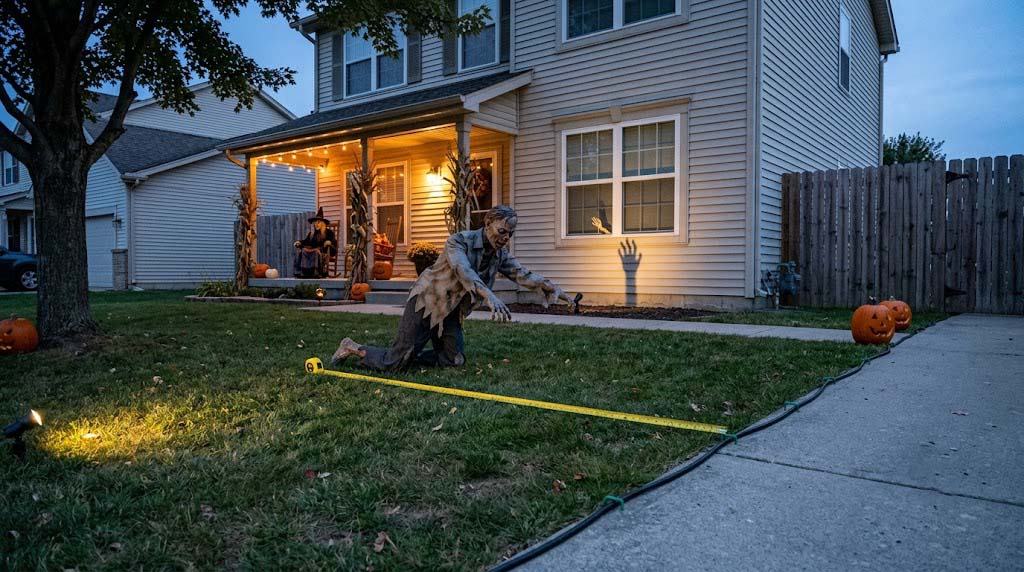
Assessing vertical clearance and base footprint
Height alone doesn’t tell the whole story — a lunging or arm-swinging figure needs a working radius well beyond its resting footprint, and failing to account for that is one of the more common reasons a prop ends up damaging itself or something nearby. Measuring the actual swing radius, not just the base dimensions listed in the product description, avoids this surprise on setup day.
Measuring on-site with the figure’s actual dimensions from the listing, rather than eyeballing the space, catches problems before they happen — a fence, low tree branch, or porch railing can interfere with a swing radius in ways that aren’t obvious until the figure is already unboxed.
Best animatronics for covered porches
A covered porch generally suits more delicate, detailed figures that run on standard wall power, since they’re protected from direct rain while still being visible from the street. It’s still worth confirming the specific product isn’t rated for fully exposed use only, since some listings assume outdoor placement means uncovered ground rather than a sheltered porch.
Porch placement also affects how a figure reads from the street, since a shallow porch can put the prop closer to viewers than a yard placement would — worth factoring into how intense a design makes sense for that specific spot.
Creating depth with yard and window placement
Placing a figure near a window with a light source behind it adds a layer of depth that a single yard prop on its own doesn’t achieve — the shadow it casts becomes part of the scene rather than just the figure itself. If you’re building out the rest of the window display to match, our best halloween window decorations guide covers the lighting and placement details that pair well with this kind of setup.
Keep the light source and any cords tucked well out of the walkway when using this technique, since the goal is a dramatic shadow effect, not a tripping hazard sitting directly in front of the door.
Real-World Installation and Weatherproofing
The truth about “weather-resistant” versus waterproof
We’ve found that a label reading weather-resistant is doing a lot of quiet work — it generally means the figure can handle light dew or a brief drizzle, not a sustained downpour. Heavy rain can still find its way into the control box. Wrapping the control unit in a plastic bag or a dedicated cord cover before a forecasted storm is a small step that avoids a much bigger repair later.
Checking connections periodically throughout the season, not just once at setup, catches slow leaks before they cause a real failure — a connector that seemed fine on day one can shift or loosen after repeated exposure to wind and rain.
Securing tall figures against October winds
Anything in the 8-foot-plus range needs more than the flimsy plastic stakes it ships with once real wind gets involved. To keep oversized figures from snapping, follow these reinforcing steps:
- Use metal U-shaped ground stakes driven at an angle over the base frame.
- Attach guy lines (heavy-duty nylon cords) from the figure’s hip or shoulder tie-down points.
- Anchor those guy lines to additional stakes driven deep into solid ground.
- Place heavy sandbags discreetly over the base stand for a lower center of gravity.
This matters even more for figures with lunging motion, since the mechanism adds extra stress. Checking the forecast and bringing a tall figure down temporarily before a serious wind event is far less work than repairing a cracked frame.
Managing power cords safely in wet grass
Running a standard indoor extension cord across damp grass is one of the more avoidable safety risks in a yard display — an outdoor-rated cord and a dedicated waterproof connector box for each junction point keeps water out of a connection that would otherwise sit directly in the wet ground overnight. Routing cords along the edge of a walkway rather than across it also removes the most common tripping hazard for trick-or-treaters.
A simple rule worth following: any cord crossing open ground should sit inside a cord cover or be elevated off the grass entirely, since standing water after rain is exactly where a damaged cord becomes a genuine hazard.
The Teardown: Proper Storage and Maintenance
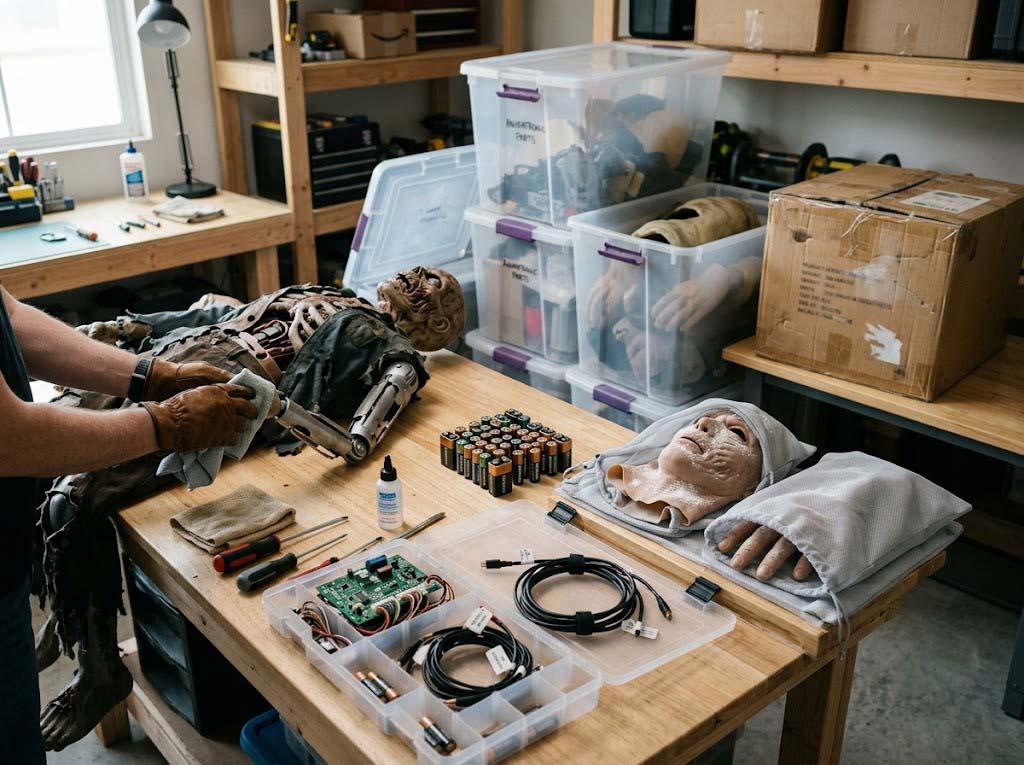
Preventing gear and motor lock-up
Packing an animatronic away with batteries still inside, or with any dampness left on the joints, is one of the more common reasons a motor seizes up by the time next Halloween rolls around. A quick pre-storage routine avoids most of this:
- Remove all batteries before boxing the figure
- Wipe down and fully dry every moving joint
- Run the motion through its full range once to confirm nothing sticks
- Repeat the same check right before sealing the storage container
Catching a stuck joint at this stage is far easier to fix than discovering it next October once the season is already underway.
Fabric care for silicone, latex, and clothing components
Silicone skin and latex clothing pieces both react poorly to heat and humidity over a long storage period — silicone can discolor or stiffen after repeated sun exposure, while latex is prone to mildew and a slow breakdown into a sticky texture. A cool, dry storage spot for both materials, plus a light dusting of cornstarch on latex surfaces before boxing them, helps prevent either issue.
Storing these pieces in a breathable fabric bag rather than sealed plastic also helps, since trapped moisture inside an airtight container is one of the more common causes of mildew showing up by the time the box gets reopened.
Box organization for oversized figures
Keeping the original packaging, if it survived unpacking, is generally the best-fitted storage option available, since it was built specifically around the figure’s shape and joints. For anyone who didn’t keep the box, a properly sized plastic tote protects the control board and mechanical joints far better than a cardboard box that’s been sitting in a garage through a humid summer.
Labeling each container with the figure’s name and a quick note on what’s inside saves real time during next year’s setup, especially once a storage space holds more than one or two seasons’ worth of decor.
Frequently Asked Questions
How much do good Halloween animatronics cost?
Pricing generally spans a wide range — basic entry-level figures often start around $100, while oversized, multi-axis premium models can run past $400. The gap usually comes down to size, the number of moving joints, and the quality of the frame and finish.
Are Halloween animatronics safe to leave outside in the rain?
Not by default — unless a listing specifically states it’s rated for waterproof or fully exposed outdoor use, most figures are only built to handle light moisture. Covering the control box or bringing the figure in during heavy rain protects the electronics far better than trusting a general “weather-resistant” label.
How do motion-activated Halloween animatronics work?
Most rely on an infrared or optical sensor that detects movement or a change in heat within a set range, typically somewhere around 3 to 5 meters, and triggers the figure’s action sequence once that threshold is crossed. Sensitivity and range vary meaningfully between models, which is part of why placement and false-trigger issues differ from one figure to the next.
How do you secure Halloween animatronics in the wind?
Sandbags at the base combined with angled ground stakes and guy lines running to additional anchor points generally hold up better than relying on the figure’s included stakes alone. Taller and heavier figures need more of this reinforcement than smaller, low-profile props.
Do Halloween animatronics use a lot of electricity?
Generally not — most rely on small motors and LED lighting rather than anything power-intensive, so running even a large figure continuously for a month typically adds only a small amount to an electric bill. Battery-powered models draw even less, though they need more frequent battery changes during heavy use.
What’s the best Halloween animatronic for a small yard or apartment balcony?
A smaller entry-level or mid-range figure with a compact footprint and adjustable volume tends to work best in tight spaces, since anything with a wide lunging motion needs clearance that a small yard simply doesn’t have. Measuring the actual available space before buying avoids ending up with a figure that can’t safely operate where it’s placed.