
No products in the cart.

Uncategorized
Creative Halloween Door Mat Ideas to Elevate Your Front Porch Decor
23
Aug
Aug
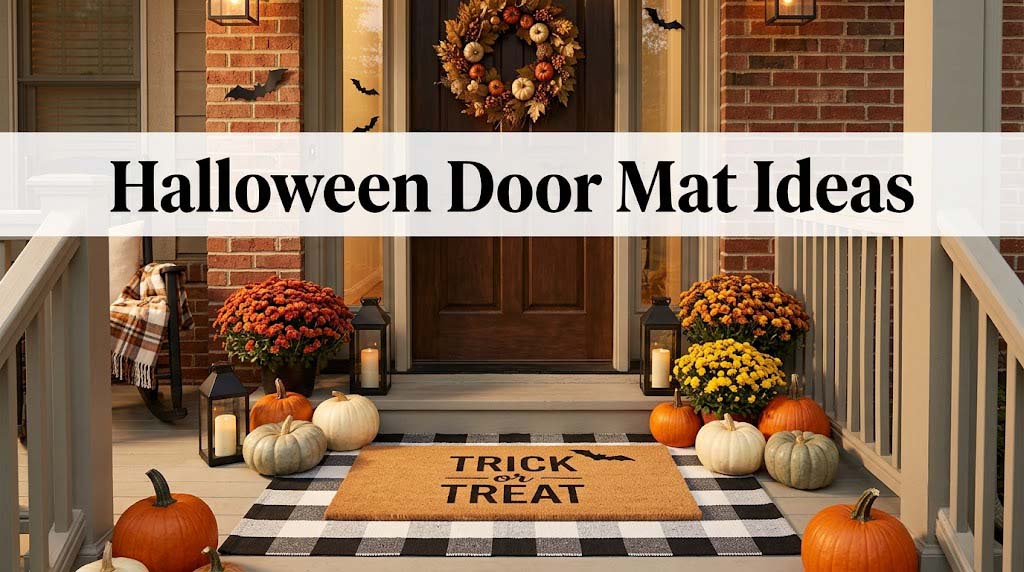
A great set of halloween door mat ideas can change the entire feel of a front entrance without a full decorating overhaul. We’ve found that homeowners tend to gravitate toward one of a few directions: a subtle minimalist graphic, a funny or witchy phrase, a personalized family design, or a hand-painted DIY project. Style is only half the equation, though. An outdoor mat has to hold up to dirt, moisture, and daily foot traffic, and that’s where a lot of Halloween decor falls short. This guide walks through the ideas themselves, plus how to layer a mat for a designer look, choose the right material for your porch conditions, and protect a coir mat once October weather sets in.
Quick Take
- Covered porch → a natural coir mat is usually the better long-term choice.
- Rain-exposed entryway → look at rubber or synthetic outdoor mats instead.
- Want a designer look? Layer an 18×30-inch coir mat over a larger patterned rug.
- DIY route → stencil, outdoor-rated paint, and a protective sealer applied after full cure.
Subtle and Stylish Halloween Door Mat Ideas
Not every homeowner wants a porch that screams Halloween the moment someone turns onto the street. If your entryway already does a lot of visual work with a wreath, potted mums, or a stack of pumpkins, a quieter mat design tends to look more intentional than a busy one. We generally recommend starting here if you’re unsure what direction to take, since a subtle mat is easier to build the rest of your decor around than the other way around.
Spiderweb, Bat, and Ghost Motifs
Small, single-corner motifs read as festive without dominating the mat. A spiderweb tucked into one corner, a scattering of bat silhouettes, or a minimal ghost outline all work well here. Crescent moons and star clusters are another quiet option that pairs easily with almost any door color.
The reason these smaller motifs work so well on a porch is negative space. A mat with a lot of open, unprinted coir is easier to read from the sidewalk and doesn’t compete visually with whatever else is sitting near the door — pumpkins, a wreath, or string lights included.
Minimalist Black-and-Orange Designs
Rather than covering the entire mat surface, a stronger approach is usually black graphic work set against the natural coir tone, with orange used sparingly as an accent rather than a dominant color. This tends to read as more modern than a mat that’s fully saturated in seasonal color.
On a modern porch — black door, neutral pumpkins — this restrained palette fits naturally. On a farmhouse-style porch, the same black motifs paired with warmer orange accents nearby still feel cohesive without looking mismatched.
Vintage and Gothic-Inspired Welcome Mats
Skeleton hand illustrations, vintage moon artwork, and apothecary or haunted-house-style graphics give a mat a slightly older, more atmospheric feel. Distressed or hand-lettered typography tends to suit rustic and traditional porches particularly well.
This category sits between a purely minimalist Halloween doormat and a full horror-themed one, which makes it a solid middle ground for anyone who wants a spooky welcome mat with some visual character but not full-on jump-scare energy.
Funny, Witchy, and Horror-Inspired Door Mat Ideas
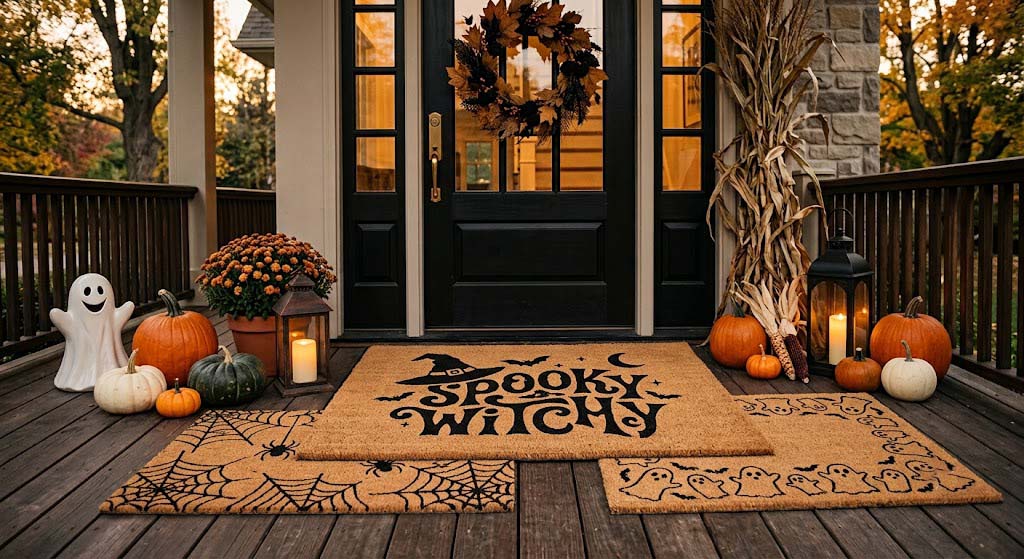
This is a separate category from the subtle designs above, and it’s worth thinking about it that way rather than trying to blend the two. A funny or horror-leaning mat is meant to be a statement piece, so it usually works best when the rest of the porch decor stays relatively simple around it.
Clever Witchy and Halloween Sayings
Witch-themed humor, trick-or-treat jokes, haunted house greetings, and dryly sarcastic “visitors beware” phrasing all fall into this bucket. Short, punchy lines — something along the lines of “Witches Welcome,” “Boo!,” or a simple “Trick or Treat” — tend to age better on a mat than a long paragraph of text, which gets hard to read from a distance and wears down faster underfoot.
Family-Friendly Halloween Humor
If your street sees a lot of trick-or-treaters, a friendlier tone usually fits better than anything horror-adjacent. Ghosts, candy imagery, pumpkins, and cartoonish skeletons keep things approachable for families with younger kids while still being clearly Halloween-themed.
This isn’t just an aesthetic preference — a mat that reads as friendly rather than frightening tends to set the tone for how welcome trick-or-treaters feel walking up to the door in the first place.
Classic Horror-Inspired Designs
For a bolder statement, mask silhouettes, haunted motel-style signage, slasher-inspired typography, and vintage horror poster color schemes all work well without needing to reference any specific film or franchise directly. We’d steer away from anything that copies exact movie quotes or branded artwork — not only for originality’s sake, but because generic “horror-inspired” designs tend to have a longer shelf life season after season.
Personalized Halloween Door Mat Ideas
Personalization is where a Halloween mat stops being purely decorative and starts feeling like it belongs specifically to your household. It’s also one of the strongest options if you’re shopping rather than making your own, since a custom design is hard to replicate with generic decor.
Family Name and Haunted House Designs
A surname worked into a “haunted house” framing — something like “The [Family Name] Haunted House,” paired with an established year or a small illustrated house — gives a mat a permanent, slightly playful identity. This style tends to stay relevant well beyond a single Halloween, since it’s less about the holiday’s specific icons and more about the household itself.
Personalized Mats for Families and Pet Owners
Representing each family member as a small ghost, adding dog or cat silhouettes, or mixing paw prints in with Halloween icons are all approachable ways to personalize a mat without overcomplicating the design. A short personalized trick-or-treat greeting works well here too.
What makes a personalized mat stand out is usually the custom text or illustration itself — a surname, a pet’s silhouette, a family headcount in ghosts — rather than anything printed elsewhere on the porch. We’ll get into how to balance a standout mat against the rest of your porch decor later in this guide.
How to Make a DIY Halloween Door Mat at Home
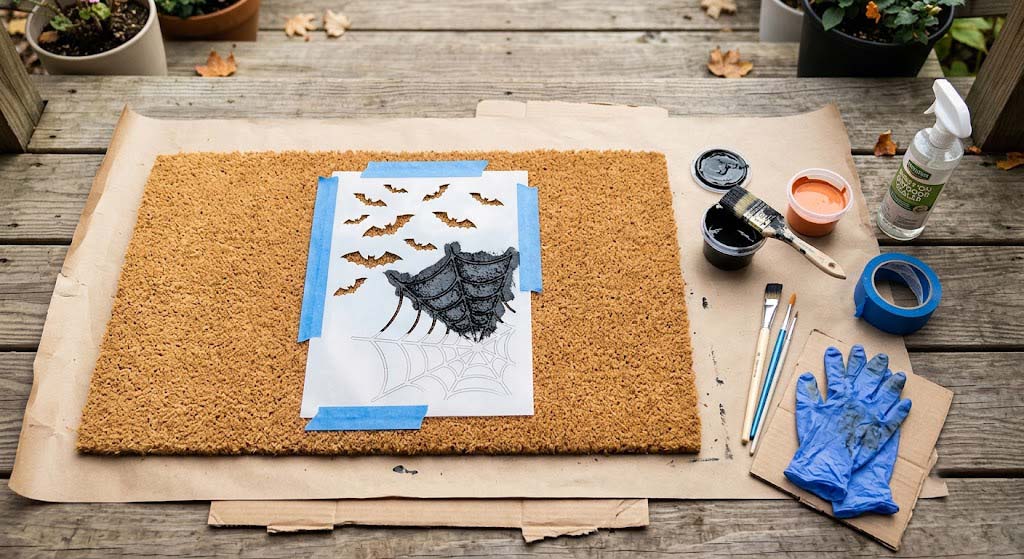
This section is about process, not more design ideas — if you already know what you want on your mat, this is where you actually make it happen.
Essential Supplies for Painting a Coir Mat
You’ll want a plain natural coir mat, outdoor-rated acrylic or latex paint, a stencil, a short stiff-bristle or stencil brush, painter’s tape, a piece of cardboard to protect your work surface, and a protective sealer for after the paint cures.
We’d recommend paint specifically formulated for exterior surfaces rather than standard craft paint if the mat is going to live outdoors. Craft paint simply isn’t built to handle sun exposure and moisture the way exterior-rated paint is, and it tends to fade or flake noticeably faster.
How to Secure a Stencil for Crisp Edges
Center the stencil where you want the design, then fix it in place with tape or pins so it can’t shift while you’re working. Use a minimal amount of paint on your brush and dab it on straight down — a stippling motion — rather than dragging the brush sideways across the stencil edge.
We learned this the hard way after ruining a couple of mats early on: coir fiber is naturally absorbent, and dragging a loaded brush across a stencil pushes paint straight under the plastic edge, blurring the design. Building the color up in several thin, dabbed-on coats takes longer but gives a noticeably cleaner line than trying to get full coverage in one pass.
Three Beginner-Friendly DIY Layouts
If you’re not sure where to start, three layouts tend to work well for a first attempt. One centered word paired with a few small bats keeps things simple and legible. A corner spiderweb combined with a clean welcome message balances open space with detail. A repeating border of ghosts or pumpkins around the mat’s edge is a bit more involved but gives a finished, professional look.
Letting the Paint Cure Before Sealing
Don’t seal the mat while the paint still feels tacky to the touch — sealing over paint that hasn’t fully cured tends to trap moisture underneath and can cause the finish to peel later. Follow the cure time listed on your paint’s packaging, and only move on to sealing once the surface is genuinely dry, not just dry to a light touch.
How to Layer Halloween Door Mats for a Designer-Looking Porch
Layering is, in our experience, the single easiest way to make a Halloween mat look intentional rather than store-bought-and-plopped-down. It’s a simple technique, but it makes a noticeable difference in how finished a porch looks in photos and in person.
Using Buffalo Plaid or Patterned Rugs as the Base Layer
A black-and-white buffalo plaid, a black check pattern, an orange-and-black print, or even a neutral striped rug all work well as a base layer. The base rug essentially creates a visual frame around the coir doormat sitting on top of it, which is what gives the layered look its polished feel.
Pairing Coir Mats With Fabric Outdoor Rugs
The contrast between the rough texture of coir and a softer woven outdoor rug underneath adds visual depth without adding visual clutter. As a general rule, we’d limit yourself to two patterns total between the base rug and the mat — beyond that, the layered look starts to feel busy instead of curated. If your top mat already has a strong graphic, keep the base rug simple.
Choosing the Correct Size for Layered Mats
As a rough guideline, the base rug should show somewhere around 2 to 4 inches of visible border around the doormat sitting on top, though the exact amount will depend on the size of both pieces. A common pairing is an 18×30-inch top mat with a base rug around 24×36 inches or slightly larger.
Keeping Layered Rugs From Sliding
An outdoor rug pad or a mat with rubberized backing will keep both layers from shifting underfoot, and it’s worth checking that the surface underneath is flat before you set anything down — curled corners are a common tripping hazard. It’s also worth double-checking that the added thickness from two layered mats doesn’t interfere with the door swing, especially with storm or screen doors.
How to Choose the Right Halloween Door Mat for Your Porch
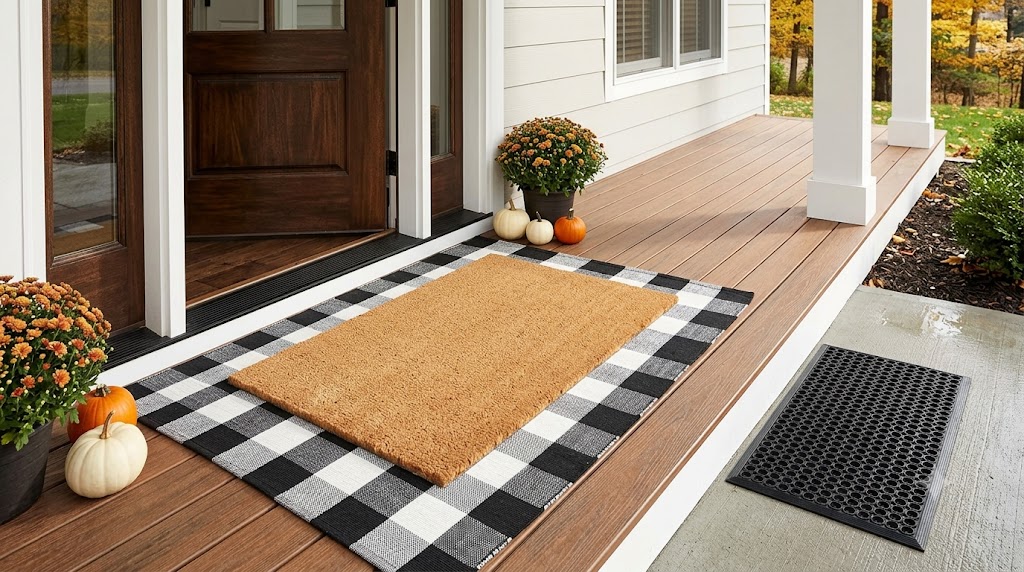
Once you’ve settled on a design direction, the material and sizing decisions matter just as much for how long the mat actually lasts through the season.
Evaluating Materials Based on Your Porch’s Weather Exposure
The right material really comes down to one question: how much rain and direct weather does your entryway actually see? On a covered porch, coir tends to be the better long-term choice — it scrapes debris off shoes well, has a classic look, and holds up to less direct rain exposure, so a painted design lasts considerably longer. On a fully exposed entryway, rubber or polypropylene tends to be more practical, since water resistance and grip matter more than appearance once a mat is taking on rain regularly.
| Material | Best For | Strength | Limitation |
|---|---|---|---|
| Coir | Covered porch | Classic look, strong scraping ability | Sensitive to prolonged moisture |
| Rubber | Wet or exposed area | Water resistance, good grip | Less natural aesthetic |
| Synthetic fiber | High-traffic entries | Easy maintenance | Appearance varies by product |
It’s worth being realistic about sealed coir here, too: a waterproof spray sealer improves resistance to moisture, but it doesn’t turn coir into a genuinely waterproof material. Repeated soaking will still shorten its lifespan even with a sealer applied, which is really the deciding factor between coir and a fully synthetic mat if your entry gets a lot of direct rain.
Choosing the Right Size and Thickness
The mat should be sized to match your doorway rather than chosen on looks alone. A standard-sized doormat usually suits a single door, while double doors generally call for a wider mat or layered rug setup. Thickness is worth checking before you buy, too — outward-swinging storm or screen doors need enough clearance to open cleanly over the mat.
Bristle Density, Backing, and Dirt Trapping
Dense coir fibers scrape debris off shoes noticeably better than a thin or loosely woven mat, and rubber backing adds grip that keeps the mat from shifting. Deep pile isn’t automatically better — for entries that deal with a lot of mud or wet leaves, cleaning performance matters more than plushness. If you’re still weighing your options at this stage, it’s worth reading through a broader breakdown of choosing the best halloween door mat for outdoor use before finalizing a purchase.
How to Weatherproof, Clean, and Maintain a Halloween Doormat
A mat that looks great on day one but falls apart by mid-October isn’t actually a good value, no matter how nice the design was. A little maintenance up front goes a long way.
Sealing a Painted Coir Doormat
Once the paint has fully cured, move the mat to a well-ventilated outdoor area and apply thin, even coats of a clear protective sealer, letting each coat dry before adding the next. A clear matte acrylic spray sealer or a UV-resistant clear enamel — the kind sold for outdoor furniture and exterior wood — both work well over exterior acrylic paint on coir. Give the final coat time to cure fully before putting the mat back at your door.
One thing we’d flag from experience: heavier “flood coat” style sealants can pool in the coir fibers and take much longer to dry than the can’s stated time suggests. Two or three light passes, spaced out over a day, dry more evenly than one thick coat.
Preventing Fading and Excessive Shedding
Keeping the mat under a roof or awning when possible is the single biggest factor in preventing fading. If one side gets noticeably more direct sun, rotating the mat occasionally helps it wear evenly. Shake or vacuum it gently rather than scrubbing aggressively, and know that some initial shedding from a new coir mat is completely normal and not a sign of a defective product.
Cleaning and Storing the Mat After Halloween
Shake off loose dirt, then brush or vacuum any remaining dry debris. Let the mat dry completely before storing it — this step matters more than people expect, since packing away a damp coir mat is one of the most common causes of mildew and mold once it’s tucked away for the season. Store it indoors somewhere dry, and avoid folding coir, since it doesn’t hold creases well and can crack along the fold line over time.
Coordinating Your Halloween Doormat With the Rest of the Porch
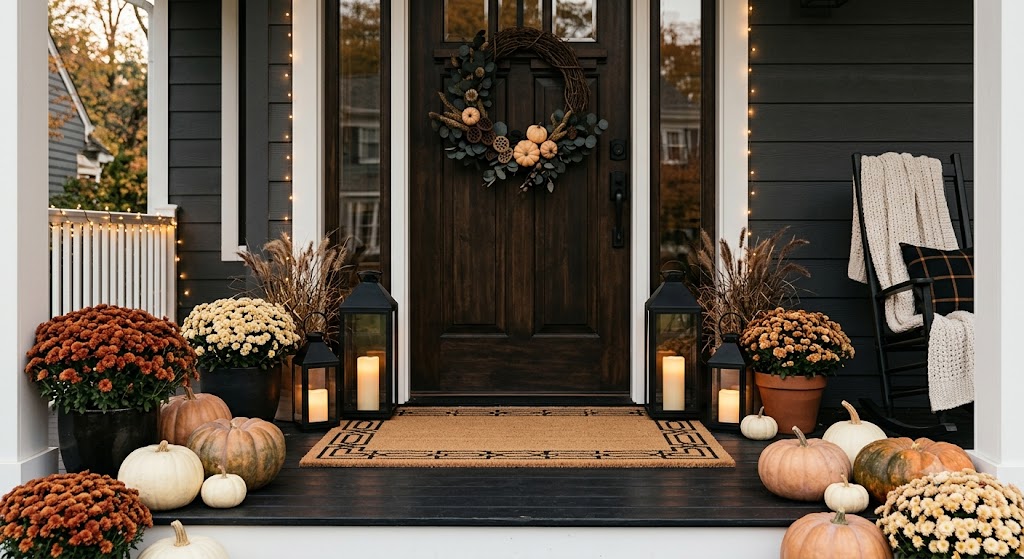
Once the mat itself is settled, the surrounding decor is what ties the whole entryway together into something that reads as cohesive rather than thrown together. As a rule of thumb across every mat style we’ve covered — personalized, funny, or minimalist — a mat that’s already doing a lot of visual work reads best when the decor around it stays simple, rather than competing with it for attention.
Framing the Entry With Pumpkins and Seasonal Plants
Clustering pumpkins at varying heights, adding mums, corn stalks, or a hay bale if your porch has the room, all frame the doorway nicely without crowding the mat itself.
Matching Wreaths, Lanterns, and Porch Lighting
A door wreath, a couple of lanterns, warm white lighting, and black metal accents all help pull the look together when their colors echo the mat. Be mindful of not overloading the space with orange — a little goes a long way once you’ve already got pumpkins and a mat in the mix.
Building a Cohesive Halloween Color Palette
Three palettes tend to work reliably across most porch styles: a classic combination of orange, black, and natural coir tones; a more modern pairing of black, cream, and muted pumpkin orange; and a gothic-leaning mix of black, burgundy, and antique brass. Picking one and sticking with it across the mat, wreath, and lighting is what separates a coordinated porch from one that just has a lot of Halloween stuff on it.
Frequently Asked Questions About Halloween Door Mats
How do you waterproof a painted coir doormat?
Seal it with a clear outdoor-rated acrylic or UV-resistant enamel spray after the paint fully cures. It won’t make the mat fully waterproof, but it does meaningfully slow color fading and fiber breakdown from moisture.
What is the best material for an outdoor Halloween doormat?
Coir for covered porches, rubber or synthetic for exposed entries. The deciding factor is how much direct rain your entryway gets, not personal style preference.
How do you layer a front porch doormat for Halloween?
Set a smaller coir mat on top of a larger patterned outdoor rug so 2–4 inches of the base rug stays visible around the edges. Secure both with a rug pad so they don’t shift underfoot.
When is the best time to put out my Halloween doormat?
Most homeowners put theirs out in late September or early October, timed with the rest of their fall decorating. There’s no fixed rule — it can also be worth tracking how many days are left until Halloween if you’re planning around a specific date.
How do you keep a coir doormat from shedding heavily?
Vacuum or shake it gently on a regular basis and avoid soaking or scrubbing it hard. Some shedding when the mat is new is normal and settles down after the first few weeks.
Can a coir doormat stay outside in the rain?
Occasional light moisture is fine, but prolonged soaking shortens its lifespan and raises the risk of mold. Coir does best under a covered entrance rather than fully exposed to rain.
Whichever direction you land on, a strong Halloween mat really comes down to balancing three things: the style you’re going for, the scale of your doorway, and how well the material matches your porch’s weather exposure. A minimalist design suits a subtle porch, a funny or personalized mat adds personality, and a DIY project gives you full creative control — but none of it holds up long without the right material choice and a little seasonal maintenance behind it.