
No products in the cart.
Halloween Gifts
How to Choose the Right Halloween Table Runner for Your Dinner Table
05
Sep
Sep
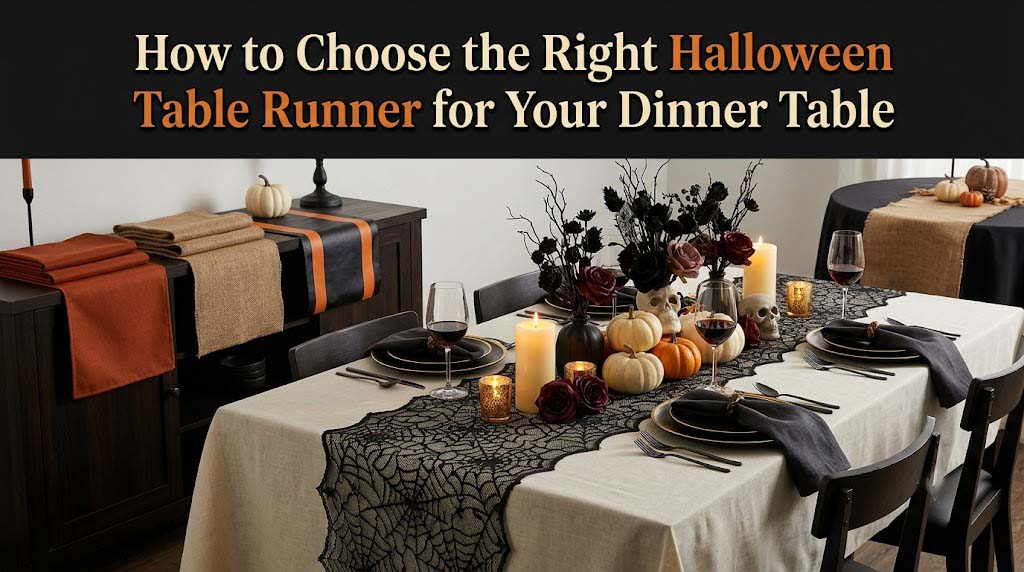
Choosing a halloween table runner comes down to more than picking a spooky print — the right one depends on whether you actually want it protecting your table or purely adding visual texture on top of a tablecloth, how long your table actually is, and how much cleanup tolerance you need for a dinner with food and drinks on it. This guide breaks down runner types by use case, walks through sizing and material trade-offs, and covers styling and care so you can shortlist the right option before you buy. If you’re counting down the days until Halloween, it’s worth ordering early enough that shipping time doesn’t become the reason your table isn’t ready.
Best Halloween Table Runners at a Glance
Comparison by Style and Use Case
Rather than ranking one single “best” runner, it’s more useful to sort by what each style is actually built to do — some are meant to protect your table, others are purely decorative.
| Category | Best For | Typical Material | Protects Table Surface | Care |
|---|---|---|---|---|
| Lace or spiderweb-cut | Layering over a tablecloth for texture | Lace, mesh, or cutwork fabric | No — decorative only | Often hand wash or delicate cycle |
| Solid polyester/microfiber | Everyday use, easy cleanup | Polyester, microfiber | Yes | Usually machine washable |
| Cotton or linen-look | Elegant, formal dinners | Cotton, cotton-blend | Yes, but can stain more easily | Check label; may need ironing |
| Burlap/jute | Rustic or farmhouse styling | Burlap, jute | Partial — coarse weave, not spill-proof | Spot clean; avoid machine wash |
| Vinyl or laminated | Kids’ parties, messy meals | Vinyl, PVC-coated fabric | Yes, wipeable | Wipe clean |
| Disposable paper | One-time events, minimal cleanup | Paper | Yes, single use | Discard after use |
Decorative Lace vs. Table-Protecting Fabric
This is worth calling out directly, since it trips up a lot of first-time buyers: a lace or spiderweb-cut runner looks striking, but the open weave means it does very little to protect your table surface from spills, heat, or scratches. If you want the visual effect of lace without losing table protection, layer it over a solid tablecloth or a plain colored runner rather than using it as your only table covering. The materials section further down goes into more depth on how each fabric actually performs once food and drinks are involved.
How to Choose the Right Halloween Table Runner
Measure Your Table and Choose Placement
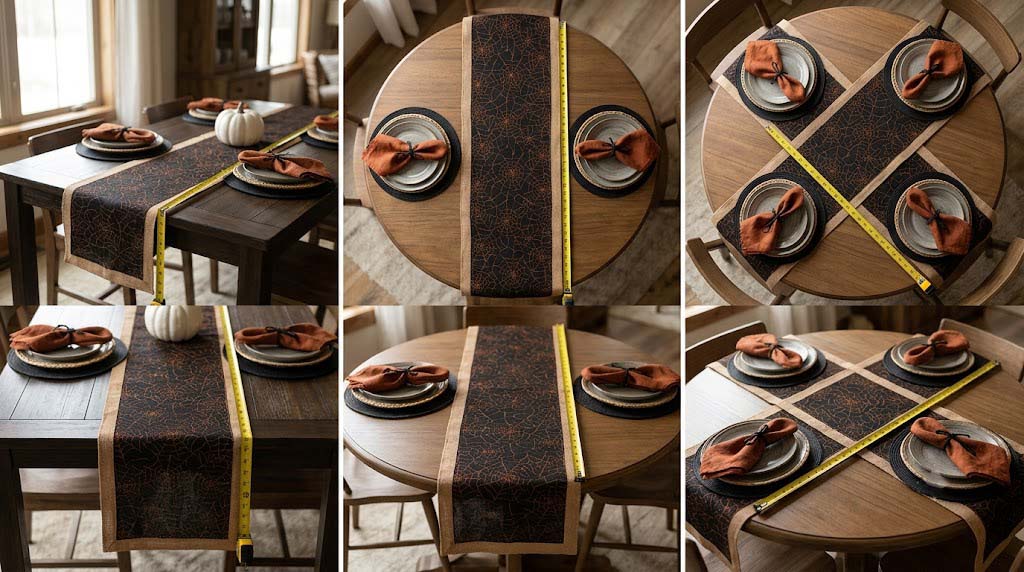
Start by measuring your table’s length and width rather than guessing from a product photo. For a standard rectangular table, most runners are meant to run lengthwise down the center, with the ends hanging off each side; add roughly 12 to 24 inches to your table’s length so each end drapes 6 to 12 inches over the edge, though this is a general guideline rather than a fixed rule, since drop preference varies by style. For a round table, you can run a runner across the diameter, cross two runners perpendicular to each other for a plus-shaped layout, or choose a shorter runner sized closer to a table topper. Buffet and console tables generally work best with a runner placed along the length of the surface to create a visual line, rather than trying to center it the way you would on a dining table.
Match Coverage to Your Dinner Setup
Decide upfront whether you want the table’s own surface or a tablecloth to show around the runner, or whether you want the runner to be the primary covering. If you’re using placemats or chargers, a narrower runner usually works better so it doesn’t compete for space with individual place settings; if you want the runner to double as your main table covering, look for a wider, solid-fabric option instead of one built for layering.
Check Construction and Care Before You Buy
Before buying, check the listing for machine-washable care instructions, expected shrinkage after washing, and whether the color is described as colorfast — this matters more with darker Halloween palettes, since bleeding dye onto a lighter tablecloth underneath is a common complaint with cheaper printed fabric. Also look at the edges: hemmed or finished edges tend to hold up to repeated washing better than raw-cut fabric, which can fray over a few seasons of use.
Best Materials for a Reusable Spooky Table Runner
Polyester and Microfiber for Easy Cleanup
Polyester and microfiber runners are generally the most forgiving option for a dinner where spills are likely, since they resist wrinkling and hold up well to repeated washing. One thing worth knowing about the fiber itself: polyester is oil-attracting by nature, so a greasy spill like gravy or buttery sauce can bond to it more stubbornly than a water-based stain would. Treating an oily spill with a degreasing dish soap before regular laundering, rather than just tossing it straight in the wash, gets noticeably better results than a plain wash cycle alone.
Cotton, Linen-Look, and Lace for an Elevated Table
Cotton and linen-look fabrics tend to drape better and photograph more elegantly than polyester, which makes them a common choice for a more formal Halloween dinner. The trade-off is that they wrinkle more easily and often need ironing between uses, and cotton in particular can hold onto stains from wine or sauce more stubbornly than a synthetic blend. Lace runners fall into a similar elevated-look category but, as covered above, function purely as a decorative layer rather than table protection.
Burlap, Felt, Vinyl, and Disposable Paper Options
Burlap and jute bring the coarse, rustic texture that suits a farmhouse or vintage Halloween look, but the loose weave doesn’t handle spills well and generally isn’t machine washable — spot cleaning is the more realistic care routine. Felt is smoother and slightly more spill-resistant but still not a wipeable surface. Vinyl or laminated runners are the most practical choice if you’re expecting a messy meal, since they wipe clean directly, and disposable paper runners solve cleanup entirely for a one-time event at the cost of being single-use.
Halloween Table Runner Styles for Different Dinner Moods
Gothic Black and Skull Patterns
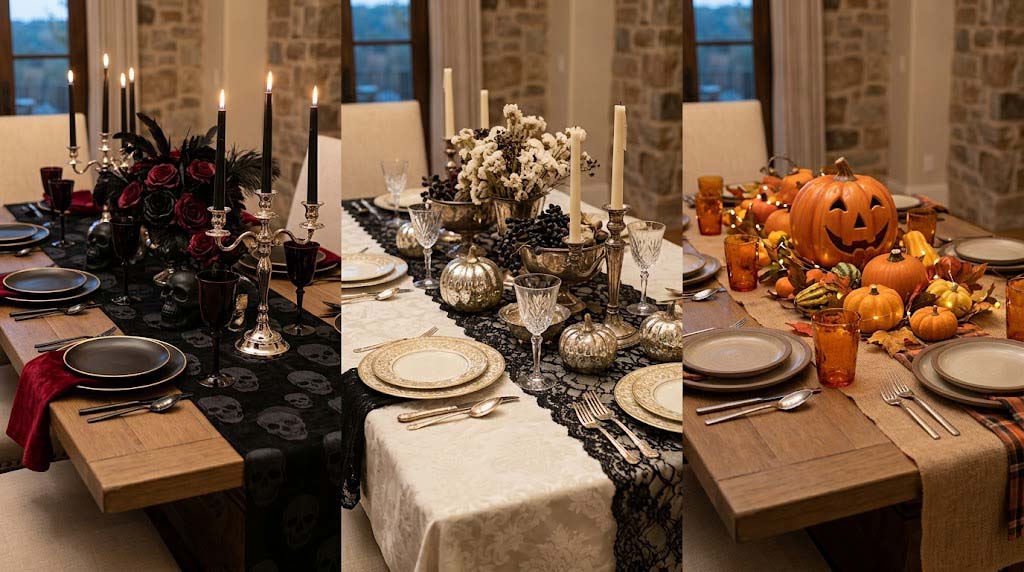
Black, charcoal, silver, and deep red combinations create a dramatic, gothic look that suits an adults-only dinner or a more theatrical Halloween gathering. One practical consideration worth keeping in mind: a table that’s too dark overall can make food harder to see clearly under dim lighting, so pairing a dark runner with lighter plates or a lighter tablecloth underneath helps balance that out.
Elegant Neutral and Vintage Halloween Patterns
Ivory, muted orange, black lace, damask prints, and botanical Halloween motifs read as more refined than bold graphic pumpkins or cartoon ghosts, which makes this category a natural fit for a dinner party where Halloween is a subtle theme rather than the main event.
Cute, Family-Friendly, and Rustic Farmhouse Designs
Friendly pumpkins, smiling ghosts, plaid patterns, and burlap with orange accents suit a casual family dinner or a gathering with kids where a wipeable, low-maintenance runner matters more than a formal aesthetic.
How to Style a Halloween Dinner Table
Build a Centerpiece Without Hiding the Runner
LED candles, small pumpkins, a skull-shaped bowl, or dried black florals arranged on a tray or cake stand keep the centerpiece elevated rather than spread flat across the runner, which lets the pattern underneath stay visible instead of getting fully covered. If you’re looking for more centerpiece and tablescape ideas beyond the runner itself, a broader collection of diy decor halloween projects can help you build out the rest of the table.
Coordinate Dinnerware, Napkins, and Glassware
Match the color palette and texture of your plates, napkins, and glassware to the runner rather than introducing a third or fourth competing pattern. If the runner is already visually busy — lace over a dark tablecloth, for instance — plain napkins and simple glassware tend to keep the table from feeling cluttered.
Make the Table Practical for Guests
Leave enough clear space for serving dishes, elbow room, and chairs to push in and out without catching on trailing fabric, especially with longer or fringed runners. If your table surface is smooth or your runner is lightweight, a thin non-slip pad or table clips underneath can keep it from sliding every time a dish gets passed across it.
Cleaning, Safety, and Storage
Handle Spills and Laundering Correctly
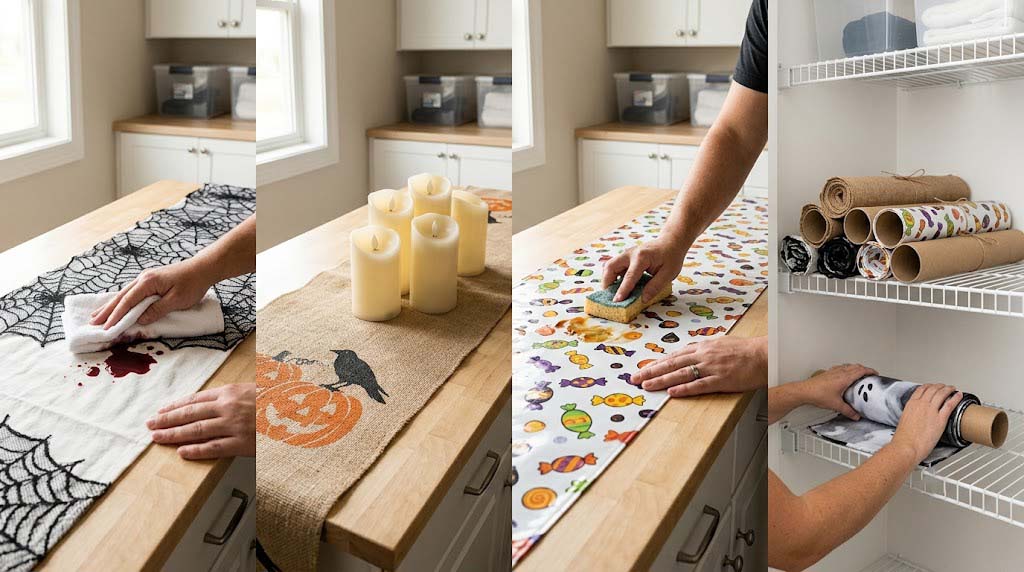
Blot spills rather than rubbing them in, and check the care label before laundering — some printed Halloween fabrics aren’t guaranteed colorfast, so testing a stain treatment on a hidden corner first is a reasonable precaution rather than assuming it will come out clean.
Use Candles, Heat, and Electronics Safely
Burlap, lace, and other loosely woven or textured fabrics are more flammable than a tightly woven synthetic, so keeping real candle flames away from the runner — and using flameless LED candles instead where possible — is a reasonable default for any Halloween table setup. The same caution applies to hot serving dishes and any electrical string lights used as part of the centerpiece; keep cords and heat sources clear of trailing fabric edges.
Roll, Don’t Fold, for Storage
Folding stiff or coated fabric — burlap, vinyl, and laminated runners in particular — creates crease lines that can become permanent, since these materials hold whatever shape they’re pressed into over months of storage. Rolling the runner around a cardboard tube, like the one from a roll of wrapping paper or paper towels, avoids that problem entirely and keeps the fabric lying flat when you take it back out next year. Lighter machine-washable cotton or polyester can tolerate folding better, since a quick iron or a few minutes in the dryer usually resets any crease, but rolling is still the safer default across every material on this list. Whatever method you use, make sure the runner is completely dry first — packing away anything even slightly damp is a common cause of musty smells or mildew by the time you unpack it again.
Frequently Asked Questions About Halloween Table Runners
How do you iron a lace or mesh Halloween table runner without melting it?
Use a low heat setting and place a thin cotton cloth between the iron and the lace rather than pressing directly on it. Synthetic lace and mesh can melt or fuse under direct high heat, so a barrier layer and a lower setting protect the material.
How do you get red wine out of a light-colored table runner?
Blot the spill immediately with a clean cloth rather than rubbing it in, then treat the spot with cold water and a small amount of dish soap or a dedicated wine stain remover before laundering according to the care label. Letting the stain dry first makes it significantly harder to remove.
Is it better to roll or fold a table runner for storage?
Rolling is the safer choice for most materials, especially burlap, vinyl, and laminated fabric, since folding creates crease lines that can become permanent over months of storage. Lighter cotton or polyester can tolerate folding better but still benefits from rolling if you want to avoid ironing before next use.
Does polyester stain more easily than cotton?
Polyester resists water-based stains reasonably well but tends to hold onto oily or greasy spills — like gravy or buttery sauce — more stubbornly than expected. Treating oily stains with a degreasing dish soap before washing gets better results than a standard wash cycle alone.
Are burlap Halloween table runners safe to use around candles?
Burlap’s loose weave makes it more flammable than tightly woven synthetic fabric, so keeping real flames away from it — and using LED candles instead — is the safer approach for a burlap-covered table.
Can I use a Halloween table runner on a round dining table?
Yes — run it across the diameter, cross two shorter runners perpendicular to each other, or use a smaller table-topper-style runner sized for round tables specifically.