
No products in the cart.
Aloha Wear
Are Hawaiian Shirts Business Casual? Office Styling Rules Explained Clearly
04
Feb
Feb
Are Hawaiian shirts business casual? The question sounds simple, yet the answer depends heavily on context, industry expectations, and styling execution. In today’s evolving workplace culture, dress codes have become more flexible than ever before. What once was strictly defined by conservative norms has gradually shifted toward comfort and individuality. However, that flexibility does not eliminate professional boundaries. Understanding whether a Hawaiian shirt fits within business casual standards requires analyzing both the garment itself and the environment in which it is worn.
A Hawaiian shirt carries strong visual identity. Its tropical prints, bold color contrasts, and relaxed construction immediately signal informality. Business casual, on the other hand, is built on the foundation of structure, subtlety, and situational awareness. The overlap between these two concepts exists, but it is narrow and highly dependent on execution. The goal of this guide is to clarify when Hawaiian shirts can function professionally, when they cannot, and how to style them appropriately in office settings.
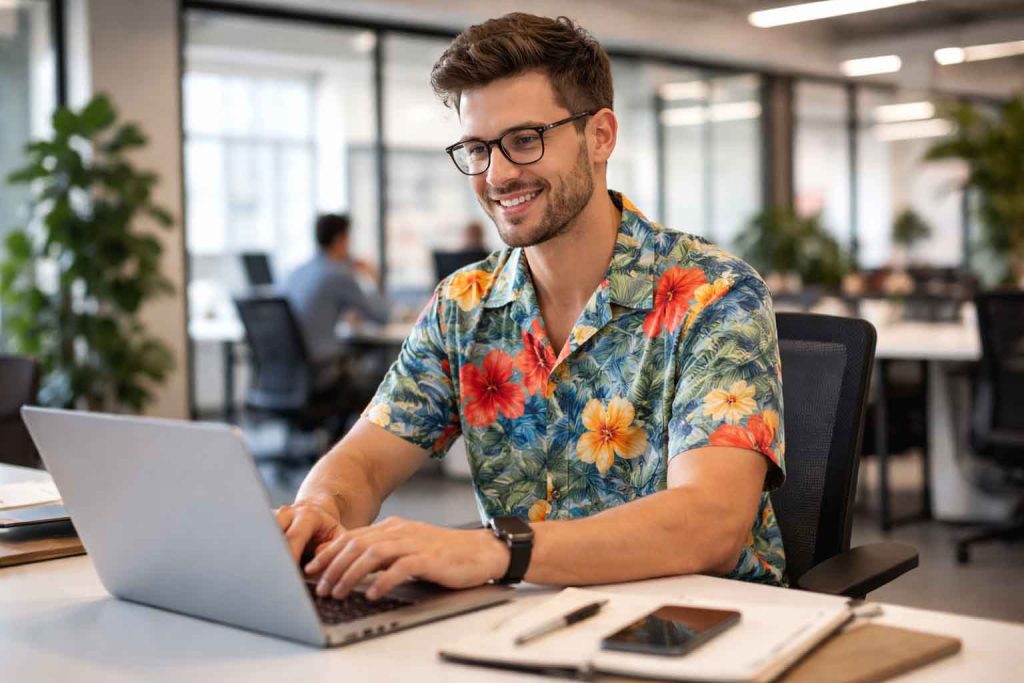
Are Hawaiian Shirts Business Casual? Understanding the Core Question
Why This Question Is More Complex Than It Appears
At face value, business casual suggests a middle ground between formal business attire and relaxed weekend wear. However, the interpretation of that middle ground varies widely across industries and even individual offices. Hawaiian shirts, often associated with vacations and leisure, introduce strong cultural and stylistic signals that may conflict with traditional office expectations. The complexity lies in how those signals are perceived within a given professional context.
A dark, small-scale tropical print worn under a structured blazer communicates something very different from a bright novelty shirt paired with sandals. The garment category alone does not determine its suitability. Instead, perception is shaped by color control, fit precision, print intensity, and the overall outfit composition. Therefore, asking whether Hawaiian shirts are business casual requires evaluating execution rather than relying on stereotypes.
The Evolution of Workplace Dress Codes
Over the past two decades, American workplace dress codes have steadily relaxed. Technology companies introduced informal norms that prioritized comfort and performance over rigid formality. Post-pandemic hybrid work models further accelerated this shift, allowing employees to blend personal style with professional presence. In many environments, business casual now includes denim, minimalist sneakers, and more expressive shirts than ever before.
However, this relaxation does not eliminate standards. Professional credibility still depends on projecting competence and situational awareness. Hawaiian shirts may fit into this new spectrum, but only when styled in a way that aligns with modern interpretations of professionalism rather than traditional vacation imagery.
What “Business Casual” Actually Means in Modern American Offices
Traditional Business Casual Standards
Traditional business casual emphasized neutral tones, structured silhouettes, and restrained patterns. Garments such as chinos, Oxford shirts, loafers, and tailored blazers defined the aesthetic. Prints were typically subtle, and bold graphics were avoided. Within this framework, Hawaiian shirts would rarely qualify as appropriate attire because their defining characteristic is visual boldness.
This conservative baseline still exists in finance, law, and certain corporate sectors. In such environments, maintaining predictability and visual restraint reinforces authority and professionalism. Deviating from that norm requires careful assessment of company culture and leadership expectations.
Modern Relaxed Business Casual
In contrast, modern business casual in creative and tech-driven industries has become more expressive. Employees are often encouraged to demonstrate individuality, provided their clothing remains polished and intentional. Clean sneakers, tailored denim, and subtle prints have become acceptable components of professional wardrobes.
Within these updated standards, Hawaiian shirts may find limited acceptance when executed with discipline. Muted palettes, structured fits, and strategic layering help bridge the gap between expressive design and workplace appropriateness. The distinction lies not in the category of shirt, but in how it integrates into a cohesive professional silhouette.
Industry-Specific Expectations
Industry culture strongly influences dress code interpretation. A graphic designer in a marketing agency operates under different visual norms than a financial analyst in a multinational bank. Creative industries often reward stylistic experimentation, while conservative sectors prioritize consistency and predictability.
Before wearing a Hawaiian shirt to the office, professionals should evaluate their industry baseline. Observing leadership attire and client-facing standards provides valuable guidance. Business casual is not universal; it is contextual.
When Hawaiian Shirts Can Be Considered Business Casual
Creative and Design-Oriented Workplaces
In creative environments, clothing often serves as an extension of personal brand. Subtle Hawaiian shirts with darker bases and refined prints can signal confidence and originality without undermining professionalism. When paired with tailored trousers and minimal footwear, the overall appearance can remain balanced and intentional.
The key lies in restraint. Avoiding loud novelty prints and exaggerated color contrasts preserves credibility. In these settings, Hawaiian shirts may align with workplace culture when they demonstrate thoughtful styling rather than casual spontaneity.
Casual Fridays and Seasonal Relaxation
Many traditional workplaces incorporate designated casual days to provide flexibility. Casual Fridays create space for slightly more expressive attire, including patterned shirts that would otherwise feel out of place. In such cases, Hawaiian shirts styled with neutral chinos and structured footwear may fit within acceptable boundaries.
Summer months also influence perception. Lighter fabrics and breathable silhouettes become more practical, and subtle tropical patterns may feel less disruptive. However, context remains critical. Seasonal comfort should not override professional standards entirely.
Internal Roles With Limited Client Interaction
Employees who primarily work internally may enjoy greater wardrobe flexibility than those who frequently meet clients. Internal collaboration settings often prioritize functionality and comfort over visual conservatism. In these contexts, carefully styled Hawaiian shirts may be tolerated more readily.
Even so, important meetings or executive presentations may still require more traditional business casual attire. Understanding situational nuance ensures that wardrobe choices support rather than hinder professional objectives.
When Hawaiian Shirts Are Not Business Casual
Conservative Corporate Environments
In industries such as banking, law, and high-level consulting, business casual retains a structured and conservative foundation. Bold prints often conflict with the understated visual language expected in these sectors. Wearing a Hawaiian shirt in such environments may signal a lack of alignment with professional norms.
The visual boldness of tropical patterns can unintentionally draw attention away from professional authority. In highly regulated or client-sensitive industries, minimizing stylistic risk is often the safer approach.
High-Stakes Professional Settings
Board meetings, investor presentations, and formal client negotiations require visual discipline. In these scenarios, projecting reliability and seriousness outweighs personal expression. Hawaiian shirts, even subtle ones, may appear too informal for such occasions.
Professional image management involves strategic restraint. Choosing conservative attire in high-stakes environments reduces unnecessary risk and ensures that focus remains on competence rather than clothing.
Job Interviews and First Impressions
First impressions carry disproportionate weight in professional contexts. Even in relaxed industries, interviews typically call for neutral, structured attire. Hawaiian shirts may be perceived as overly casual or inattentive to professional expectations.
Establishing credibility first allows greater stylistic flexibility later. When uncertainty exists, erring on the side of formality is generally advisable.
What Makes a Hawaiian Shirt Office-Friendly?
Controlled Color Palette and Muted Prints
Not all Hawaiian shirts are created equal, and this distinction becomes critical when evaluating whether they can function within business casual boundaries. Office-friendly hawaiian shirts typically feature darker base colors such as navy, charcoal, deep green, or muted burgundy. These subdued backgrounds reduce visual intensity and make tropical patterns feel more integrated rather than overwhelming. Bright neon tones or exaggerated novelty graphics, on the other hand, amplify informality and risk undermining professional perception.
Color control does not mean eliminating personality. Instead, it means selecting prints that express subtlety rather than spectacle. Smaller floral motifs, tonal patterns, or low-contrast designs allow the shirt to retain its identity while aligning more closely with workplace expectations. The difference between a vacation shirt and an office-adapted Hawaiian shirt often lies in restraint.
Smaller Pattern Scale and Subtle Design
Pattern scale significantly influences whether Hawaiian shirts are business casual. Large, high-contrast tropical scenes naturally communicate leisure. Smaller, refined prints appear more deliberate and less distracting in professional settings. When pattern density is controlled, the shirt feels more like a design choice than a novelty statement.
Subtle design also enhances versatility. Shirts that avoid exaggerated graphics or humor-based imagery integrate more smoothly into structured outfits. By reducing visual noise, the garment becomes adaptable rather than attention-seeking, increasing its potential to function in business casual environments.
Fit, Fabric, and Construction
Fit often determines professionalism more than print. A Hawaiian shirt that sits cleanly at the shoulders, maintains moderate sleeve length, and falls neatly along the torso instantly appears more refined. Oversized silhouettes, dropped shoulders, or excessively long hems can make the shirt appear careless regardless of print subtlety.
Fabric choice reinforces this impression. Structured cotton or blended fabrics hold shape better than ultra-light rayon in formal settings. Crisp construction communicates intention, which is essential when navigating the boundary between relaxed style and professional credibility.
How to Style Hawaiian Shirts Professionally in Office Settings
Pairing With Structured Trousers
When asking are hawaiian shirts business casual, styling plays a decisive role. Pairing a refined Hawaiian shirt with tailored trousers instantly elevates its perception. Neutral trousers in navy, charcoal, or beige provide structure that grounds the expressive upper half. The sharp lines of tailored pants counterbalance the relaxed connotation of tropical prints.
The objective is proportional harmony. Slim or straight cuts typically work best, as they maintain modern silhouette alignment without exaggerating volume. Avoiding overly relaxed trousers ensures that the shirt appears intentional rather than casual.
Choosing Professional Footwear
Footwear completes the professional equation. Minimal leather sneakers, suede loafers, or classic derbies reinforce structure while maintaining comfort. Footwear should remain understated to prevent competing with the shirt’s pattern.
Sandals, flip-flops, or heavily athletic sneakers typically undermine business casual credibility. Shoes communicate seriousness; therefore, choosing polished styles strengthens the overall presentation.
Strategic Layering for Refinement
Layering offers one of the most effective methods to moderate bold prints. An unstructured blazer or lightweight cardigan can frame the shirt, reducing its visual dominance. This added structure softens tropical elements and aligns the outfit more closely with business casual expectations.
The key is subtlety. Layers should complement rather than obscure the shirt. A dark blazer over a muted Hawaiian print creates balance, demonstrating that styling discipline can transform perception.
Are Hawaiian Shirts in Style in the Workplace Right Now?
The Casualization of American Workwear
The broader trend toward relaxed dress standards has prompted many professionals to ask whether are hawaiian shirts in style within office contexts. Over the past decade, the blending of streetwear and professional attire has blurred traditional boundaries. Expressive prints and softer silhouettes have gained cultural acceptance, especially in innovation-driven sectors.
However, being in style does not automatically translate to being appropriate. Workplace style must balance trend awareness with situational sensitivity. A garment can be fashionable while still exceeding professional comfort zones in certain industries.
Trend Acceptance vs Professional Approval
Fashion trends move quickly, but professional standards evolve more gradually. Hawaiian shirts may cycle into mainstream popularity, yet conservative offices may resist that shift. This distinction explains why are hawaiian shirts in style is not the same question as are hawaiian shirts business casual.
Understanding this difference helps professionals navigate style confidently without misjudging environment. Professional approval depends less on trend cycles and more on contextual judgment.
Psychological and Professional Impact of Wearing Bold Prints
Authority vs Approachability
Clothing influences perception at a psychological level. Bold prints often increase approachability by signaling creativity and openness. However, they may simultaneously reduce perceived authority in conservative environments. Striking the right balance requires understanding workplace culture and personal role.
Professionals in leadership positions may need to project consistency and stability, while those in creative roles may benefit from expressive individuality. The impact of Hawaiian shirts therefore depends on how the wearer wishes to be perceived.
Risk Management in Professional Image
Professional attire functions as a form of risk management. Choosing conservative clothing minimizes potential misinterpretation. Introducing bold prints increases stylistic risk but may also differentiate personal brand in appropriate contexts.
Evaluating this trade-off requires situational awareness. When uncertainty exists, erring toward moderation preserves credibility.
Comparing Hawaiian Shirts to Other Business Casual Options
Hawaiian Shirts vs Polo Shirts
Polo shirts offer a safer entry point into relaxed professional attire. Their structured collar and minimal pattern make them widely accepted within business casual frameworks. Hawaiian shirts, by contrast, require more strategic styling to achieve similar credibility.
The difference lies in visual intensity. Polos communicate simplicity; Hawaiian shirts communicate personality. Choosing between them depends on context and tolerance for stylistic boldness.
Hawaiian Shirts vs Oxford Button-Downs
Oxford shirts represent the traditional benchmark for business casual. Their predictable structure and neutral tones make them universally acceptable. Hawaiian shirts must work harder to achieve similar professional acceptance.
Layering and color control can narrow this gap, but in conservative environments, Oxford shirts remain the safer choice.
Can Hawaiian Shirts Work in Matching Hawaiian Outfits for Corporate Events?
Company Retreats and Informal Gatherings
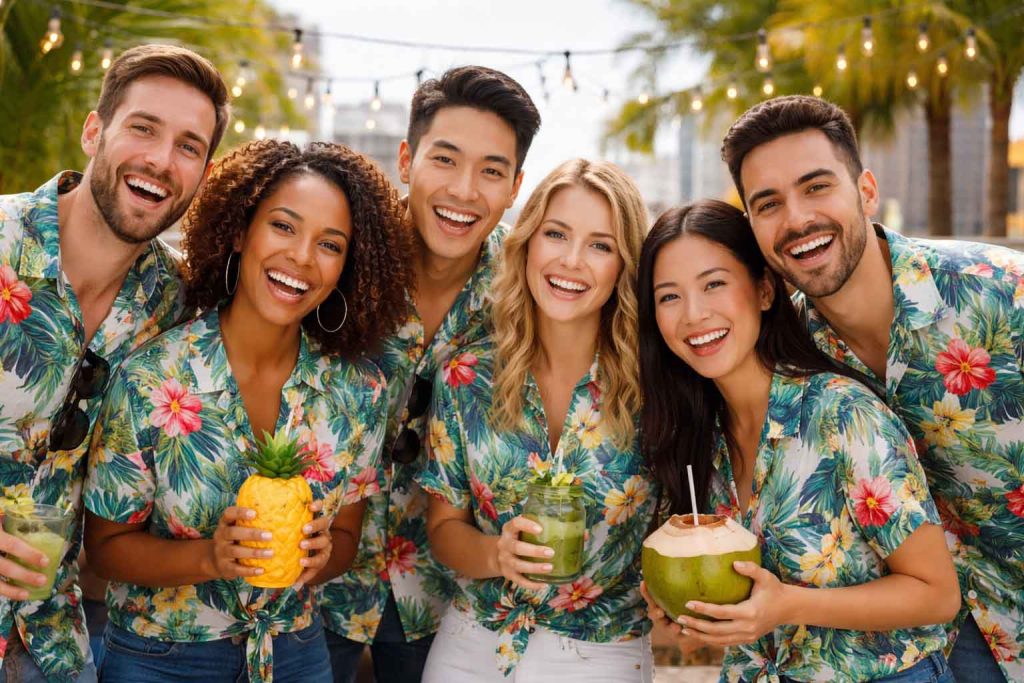
Corporate retreats, themed events, and off-site gatherings provide opportunities for relaxed coordination. In these contexts, Matching Hawaiian Outfits can foster team cohesion and create shared identity. When environment supports informality, coordinated tropical prints can feel celebratory rather than inappropriate.
However, even in relaxed events, moderation matters. Selecting muted designs and structured fits prevents coordinated outfits from appearing theatrical. Matching Hawaiian Outfits should feel intentional, not costume-like.
Balancing Fun With Professional Standards
The success of coordinated outfits depends on maintaining professional boundaries. Shirts should remain well-fitted, colors controlled, and overall styling cohesive. When executed thoughtfully, group coordination enhances unity without sacrificing credibility.
Corporate environments value balance. Even during informal events, projecting awareness of brand image remains essential.
Final Verdict: Are Hawaiian Shirts Business Casual?
A Structured Decision Framework
To determine whether Hawaiian shirts are business casual in your specific situation, evaluate four variables: industry expectations, client exposure, print subtlety, and styling discipline. Darker tones, refined prints, tailored trousers, and professional footwear increase likelihood of acceptance.
Conversely, bright novelty designs, oversized fits, and overly relaxed styling reduce professional credibility. The garment itself is not inherently inappropriate; its execution determines outcome.
The Professional Bottom Line
So, are hawaiian shirts business casual? In certain creative, relaxed, or seasonal contexts, yes—when styled carefully. In conservative corporate or high-stakes settings, generally no. Professional image management requires contextual awareness rather than blanket assumptions.
Understanding nuance empowers professionals to make informed wardrobe decisions. Hawaiian shirts can occupy a narrow but legitimate space within modern business casual wardrobes when discipline and judgment guide execution.
FAQ – Are Hawaiian Shirts Business Casual?
Are Hawaiian shirts business casual in corporate offices?
In traditional corporate offices, Hawaiian shirts are rarely standard business casual attire. However, in relaxed or creative corporate cultures, subtle and well-structured versions may be tolerated. Industry norms and leadership examples provide the clearest guidance.
Is a hawaiian shirt business casual for interviews?
Interviews typically require conservative choices. Even in relaxed industries, neutral button-down shirts reduce risk and reinforce seriousness. Hawaiian shirts may be perceived as too informal for first impressions.
Are hawaiian shirts in style in office environments?
While are hawaiian shirts in style in broader fashion cycles, workplace suitability depends on context. Trend relevance does not automatically equal professional acceptance.
Can teams wear Matching Hawaiian Outfits for company events?
Matching Hawaiian Outfits may work for retreats or themed gatherings when styled with restraint. Muted prints and proper fit help maintain professionalism.
What makes a Hawaiian shirt office-friendly?
Darker colors, smaller patterns, structured fit, and professional styling elements such as tailored trousers and polished footwear increase the likelihood that a Hawaiian shirt will align with business casual expectations.