
No products in the cart.

Easter Gift Ideas
What Day Does Easter Fall On? Date Range, Rules and Why It Changes Every Year

20
Feb
Feb
What day does easter fall on? Unlike fixed-date holidays such as Christmas, Easter does not occur on the same calendar date each year. Instead, it follows a rule tied to the spring equinox and the lunar cycle. Because of this calculation system, Easter can fall on different Sundays between late March and late April. Understanding this rule also helps clarify related questions such as when is easter day, what day is easter in 2026, and how is easter day determined.
In the United States, Easter is always celebrated on a Sunday. However, the exact calendar date shifts each year within a defined range. This guide explains what day does easter fall on, what days it can fall on, and why the date moves annually.
What Day Does Easter Fall On Each Year?
Easter always falls on a Sunday, but the calendar date changes from year to year. The holiday can occur on any Sunday between March 22 and April 25. This range represents the earliest and latest possible Easter dates under the Western Christian calculation system used in the United States.
Why Easter Is Always on a Sunday
Christian tradition holds that Jesus rose from the dead on the first day of the week, which is Sunday. As a result, Easter is permanently anchored to Sunday observance. The variability applies only to the calendar date, not the weekday.
This distinction is important. When people ask what day does easter fall on, they are typically asking about the calendar date rather than whether Easter might occur on a weekday.
What Day Does Easter Land On This Year?
Another common variation of the search query is what day does easter land on this year. The answer depends entirely on the year in question and the timing of the first full moon after March 21.
For example, in 2026, what day is easter in 2026 results in Sunday, April 5. In other years, Easter may fall in late March or much later in April.
What Days Can Easter Fall On?
To fully answer what day does easter fall on, it is helpful to identify the entire range of possible dates. Easter can fall on any Sunday between March 22 and April 25. These boundary dates are determined by the interaction between the spring equinox and the lunar cycle.
The Earliest Possible Easter Date
The earliest possible Easter date is March 22. This occurs when the first full moon after March 21 falls on March 21 itself and the following day is Sunday. While rare, this configuration is theoretically possible under the established rules.
Because such early occurrences are uncommon, many Americans are surprised when Easter appears in March.
The Latest Possible Easter Date
The latest possible Easter date is April 25. This happens when the first full moon after March 21 occurs relatively late in the lunar cycle, pushing Easter toward the end of April.
Years with a late Easter often shorten the gap between Easter and early summer events, influencing school calendars and seasonal planning.
How Is Easter Day Determined?
To understand what day does easter fall on, one must examine how is easter day determined. The calculation method was standardized in the fourth century and remains in use today. Easter is set as the first Sunday after the first full moon that occurs on or after March 21, which is treated as the ecclesiastical spring equinox.
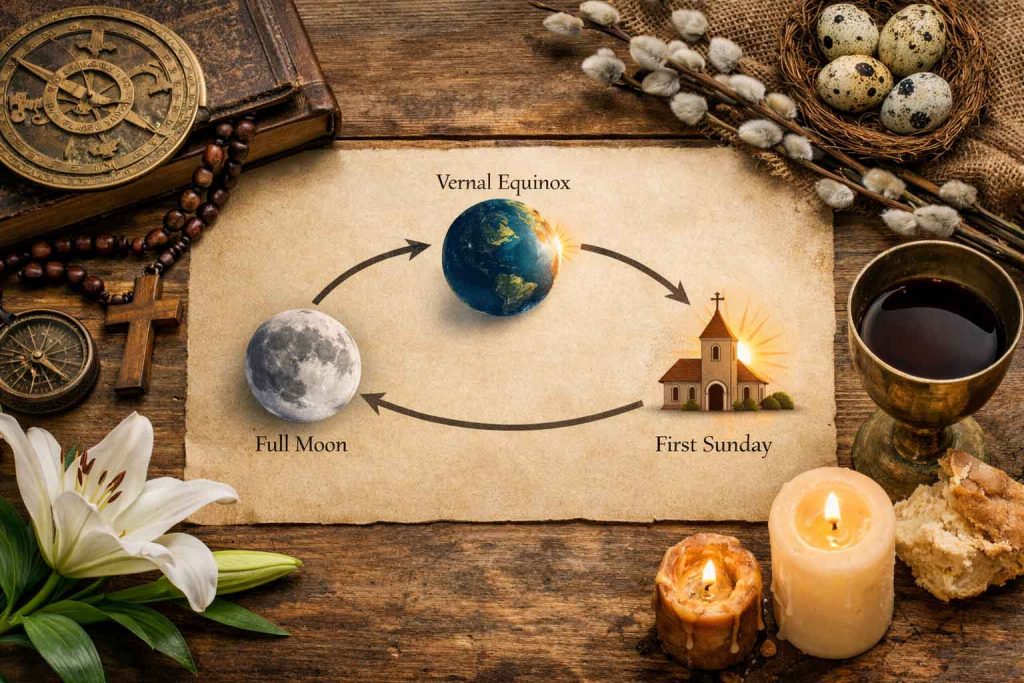
The Role of the Spring Equinox
For church purposes, the equinox is fixed at March 21 regardless of astronomical variations. This fixed date simplifies the calculation process. Once March 21 has passed, the next full moon becomes the key reference point.
This structure ensures that Easter remains linked symbolically to both the spring season and the lunar calendar.
The Full Moon and the Sunday Rule
After identifying the first full moon following March 21, Easter is assigned to the next Sunday. If the full moon falls on a Sunday, Easter is celebrated the following Sunday instead.
This calculation explains why Easter shifts annually and why many continue to search what day does easter fall on each year.
When Is Easter Day Compared to Other Christian Observances?
Because Easter anchors the Christian liturgical calendar, knowing when is easter day determines the timing of several related observances. Lent, Holy Week, and Pentecost are all calculated relative to Easter Sunday.
Lent and Ash Wednesday
Ash Wednesday occurs 46 days before Easter Sunday. Therefore, once the Easter date is determined, the entire Lenten season can be mapped backward from that point.
This interconnected structure reinforces why understanding what day does easter fall on has broader calendar implications.
Holy Week Placement
Holy Week includes Palm Sunday, Maundy Thursday, and Good Friday, all leading up to Easter Sunday. The placement of these observances shifts annually in direct response to Easter’s calculated date.
For example, when Easter falls on April 5, as it does in 2026, Good Friday occurs two days earlier.
What Day Does Easter Fall On in 2026?
To provide a clear example of how the rule works in practice, it is useful to look at a specific year. Many Americans searching what day does easter fall on want a concrete answer for planning purposes. In 2026, Easter Sunday falls on April 5 in the United States.
This example helps illustrate how the equinox and full moon calculation produces a specific calendar date. If you are looking for the confirmed answer for that year, what day is easter in 2026 results in Sunday, April 5.
Why Easter Falls on April 5 in 2026
The first full moon after March 21 in 2026 occurs at a point in the lunar cycle that places the following Sunday on April 5. Because Easter must be celebrated on a Sunday, that date becomes the official observance.
This example demonstrates the practical application of the rule described earlier in how is easter day determined.
How 2026 Compares With Nearby Years
When comparing 2026 to adjacent years, it becomes clear how variable Easter can be. Some years position Easter closer to late March, while others push it toward late April.
These differences reinforce why the question what day does easter fall on remains relevant every year, even though the calculation formula itself does not change.
Why the Easter Date Changes Every Year
One of the most persistent questions surrounding Easter is why the date shifts annually. The answer lies in the interaction between the solar calendar and the lunar cycle. Because the Gregorian calendar does not align perfectly with lunar phases, Easter cannot be fixed to a single civil date.

The Influence of the Lunar Calendar
The lunar cycle lasts approximately 29.5 days. Because the first full moon after March 21 varies from year to year, the Sunday that follows also changes.
This variability explains why people frequently ask what day does easter fall on rather than assuming a consistent date from memory.
Historical Standardization of the Calculation
The Council of Nicaea in 325 AD established a standardized method for calculating Easter in order to unify Christian communities. The council determined that Easter would be observed on the first Sunday after the first full moon following March 21.
This decision created a uniform system that remains in use in Western Christianity, including in the United States.
What Day Does Easter Fall On and Why It Matters for Civil Planning
Although Easter is a religious holiday, its timing has practical implications for civil life in the United States. Schools, businesses, and community organizations often schedule events around Easter weekend.
Impact on School Calendars
Spring break sometimes coincides with Easter, though not always. Because Easter moves annually, its relationship to school schedules shifts as well.
Understanding what day does easter fall on allows families and educators to plan more effectively.
Travel and Family Gatherings
Easter weekend often prompts family travel and gatherings. Airline bookings and hospitality reservations can increase around the holiday.
Knowing when is easter day and confirming the specific Sunday helps families coordinate travel plans well in advance.
How Easter’s Date Influences the Broader Religious Year
Easter functions as the central anchor of the Christian liturgical calendar. Once the Easter date is determined, multiple other observances can be calculated relative to it.
The Relationship to Lent
Lent begins on Ash Wednesday, which occurs 46 days before Easter Sunday. Therefore, the entire Lenten season depends on accurately determining what day does easter fall on.
This connection illustrates why Easter’s variability has cascading effects across the religious calendar.
Pentecost and Post-Easter Observances
Pentecost occurs 50 days after Easter Sunday. Like Lent, it shifts each year according to the Easter date.
This interconnected structure reinforces the importance of understanding how is easter day determined and why the calculation matters beyond a single Sunday.
What Days Can Easter Fall On Historically?
Looking at historical patterns provides additional context. Over centuries, Easter has occurred on every possible Sunday between March 22 and April 25, though some dates are far rarer than others.
Frequency of Early vs. Late Easter
Statistically, Easter is more likely to fall in early to mid-April than at the extreme ends of the range. This distribution reflects the structure of the 19-year lunar cycle used in the ecclesiastical calculation.
Because most people experience Easter within a narrower subset of dates, rare early or late occurrences often generate renewed interest in what day does easter fall on.
Why the Date Pattern Repeats
The calculation of Easter follows a 19-year Metonic cycle, which approximates the alignment of solar and lunar calendars. While not exact, this cycle produces repeating patterns over time.
Even so, confirming the specific date for each year—such as what day is easter in 2026—remains necessary for accuracy.
Frequently Asked Questions About What Day Does Easter Fall On
What day does Easter fall on?
Easter falls on the first Sunday after the first full moon occurring on or after March 21. As a result, it can fall between March 22 and April 25.
What days can Easter fall on?
Easter can occur on any Sunday within the March 22 to April 25 range under the Western Christian calendar.
What day does Easter land on in 2026?
Easter in 2026 falls on Sunday, April 5.
How is Easter day determined?
Easter is determined by a rule established in the fourth century that links the holiday to the spring equinox and the first full moon thereafter.
Is Easter always in April?
No. Easter may fall in late March or at any point in April, depending on the lunar cycle.