
No products in the cart.

Easter Gift Ideas
How Is Easter Day Determined? Full Explanation of the Calculation and Date Rule
24
Feb
Feb
How is easter day determined? This question resurfaces every spring in the United States because Easter does not remain fixed to a single calendar date. Unlike holidays such as Christmas, which is always observed on December 25, Easter moves between late March and late April depending on a calculation established centuries ago. To understand how is the day of easter determined, it is necessary to look beyond the modern civil calendar and examine the interaction between solar seasons, lunar cycles, and early church decisions that formalized the rule still used today. The shifting date is not arbitrary, nor is it random; rather, it follows a precise formula that explains both what determines easter day and why so many Americans ask what day does easter fall on each year.
How Is Easter Day Determined Each Year?
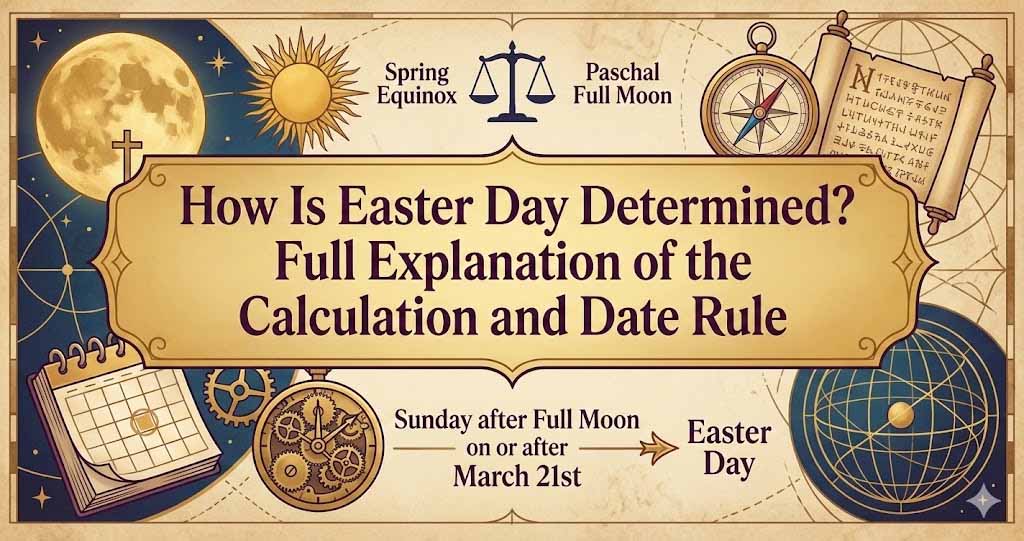
Easter is determined as the first Sunday after the first full moon that occurs on or after March 21. For ecclesiastical purposes, March 21 is treated as the fixed date of the spring equinox, even though the astronomical equinox can vary slightly from year to year. Once March 21 has passed, the next full moon becomes the key reference point. Easter Sunday is then celebrated on the first Sunday that follows that full moon. If the full moon itself falls on a Sunday, Easter is observed on the following Sunday instead. This rule ensures that Easter always occurs in the spring season in the Northern Hemisphere while also preserving its historical and theological relationship to the lunar calendar.
The Fixed Reference Date of March 21
Although the astronomical spring equinox may occur on March 19, 20, or 21 depending on the year, the ecclesiastical calculation of Easter uses March 21 as a permanent reference point. This simplification was introduced to create consistency and avoid disputes that might arise from relying on observational astronomy. By fixing the equinox to March 21, church authorities ensured that the starting point for the Easter calculation would remain stable across centuries. This decision plays a crucial role in answering how is easter day determined because it establishes the seasonal boundary that defines when the relevant full moon must occur.
The First Full Moon After the Equinox
Once the fixed equinox date has passed, attention shifts to the lunar cycle. The moon completes a full cycle approximately every 29.5 days, meaning that the date of the full moon changes each month relative to the civil calendar. Easter depends specifically on the first full moon that occurs on or after March 21. Because that full moon may occur at different points in March or April each year, the Sunday that follows also shifts. This is the central reason why is easter on different days from one year to the next. The interplay between the solar-based equinox and the lunar-based full moon introduces variability while still adhering to a consistent rule.
What Determines Easter Day: The Interaction of Solar and Lunar Cycles
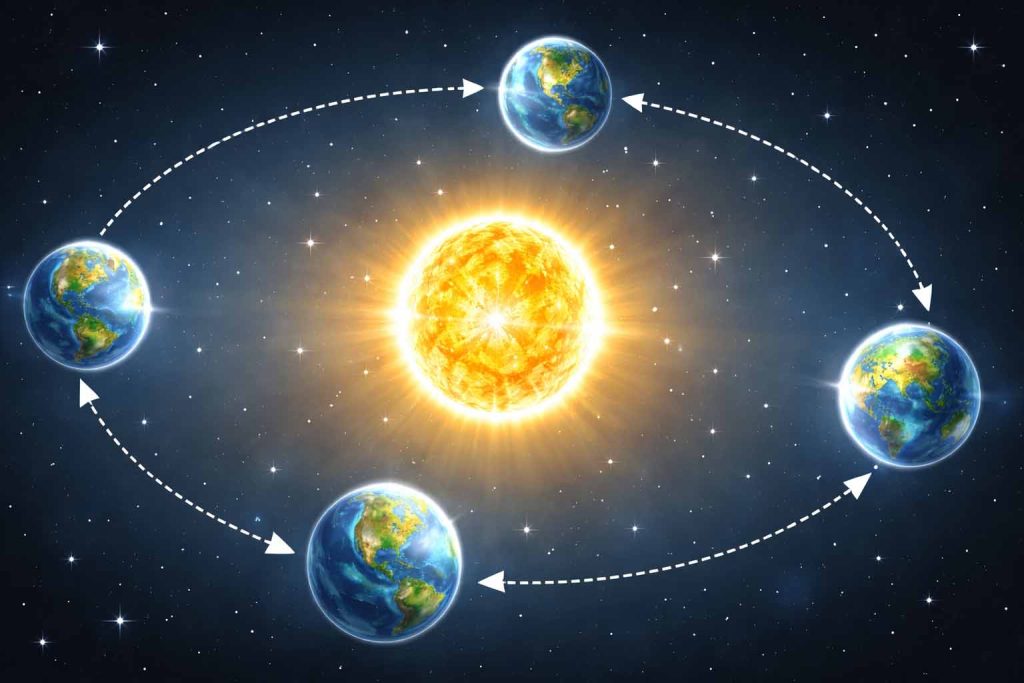
To fully understand what determines easter day, one must recognize that Easter is governed by both the solar calendar and the lunar calendar simultaneously. The Gregorian calendar used in the United States tracks the Earth’s orbit around the sun and defines the seasons. The lunar cycle, however, follows the phases of the moon, which do not align perfectly with solar months. Because Easter is tied to a full moon occurring after a specific seasonal marker, it occupies a unique position that bridges these two systems. The necessity of reconciling solar and lunar timekeeping is precisely what creates the annual variation in the Easter date.
The Solar Calendar and the Spring Season
The solar calendar establishes the seasons by measuring the Earth’s revolution around the sun. The spring equinox marks the moment when day and night are approximately equal in length and signals the beginning of spring in the Northern Hemisphere. By anchoring Easter to the equinox, early Christian leaders ensured that the holiday would always occur in the spring season, symbolically associated with renewal and new life. This seasonal requirement is fundamental to how is easter day determined, as it guarantees that Easter will not drift into winter or summer regardless of lunar fluctuations.
The Lunar Cycle and Its Influence on the Date
While the solar calendar governs the seasons, the lunar cycle determines the phases of the moon. Because the moon’s cycle does not divide evenly into the solar year, full moons occur on shifting civil dates each year. Easter’s dependence on the first full moon after March 21 means that even small changes in lunar timing can move Easter forward or backward by several weeks. This dynamic explains why the holiday can fall as early as March 22 in some years and as late as April 25 in others. The calculation is consistent, but the underlying astronomical realities create visible variation in the final date.
Why Is Easter on Different Days Every Year?
The question why is easter on different days is directly answered by the interaction between the fixed equinox date and the shifting lunar cycle. Because the first full moon after March 21 does not occur on the same civil date each year, the Sunday that follows it also changes. Unlike fixed-date holidays that rely solely on the solar calendar, Easter depends on a hybrid system that incorporates both astronomical and ecclesiastical components. This hybrid nature is what distinguishes Easter from other major holidays and explains why confirming when is easter day remains necessary each year.
The Sunday Requirement
In addition to the equinox and full moon rules, Easter must be celebrated on a Sunday. This requirement reflects the belief that the resurrection occurred on the first day of the week. Because of this condition, the calculation does not simply identify the full moon date itself but instead selects the first Sunday that follows it. If the full moon happens to occur on a Sunday, Easter is deferred to the next Sunday to preserve the sequence. This additional step contributes to the variability of the date and further clarifies how is the day of easter determined within the established framework.
The 35-Day Date Range
As a result of these combined rules, Easter can fall on any Sunday between March 22 and April 25. This 35-day range represents the complete spectrum of possible dates under the Western Christian calendar. Years in which the full moon occurs shortly after March 21 will produce an earlier Easter, while years in which the full moon occurs later in April will push Easter toward the end of its possible range. This structure explains both the consistency of the calculation and the apparent unpredictability of the outcome from year to year.
The Historical Origins of the Easter Calculation Rule
To fully understand how is easter day determined, it is necessary to examine the historical moment when the calculation was standardized. In the early centuries of Christianity, different communities observed Easter on different dates, often leading to confusion and disagreement. Some groups tied the celebration directly to the Jewish Passover date, regardless of the day of the week, while others insisted that Easter must always fall on a Sunday. This lack of uniformity created practical and theological tensions across regions. The need for a consistent rule ultimately led church leaders to formalize the calculation method during the fourth century, ensuring that Christians across the Roman Empire would observe the resurrection on the same day each year.

The Council of Nicaea in 325 AD
The Council of Nicaea, convened in 325 AD, played a central role in establishing the unified method used to determine Easter. While the council did not produce the full modern computational tables used today, it affirmed the principle that Easter should be celebrated on the first Sunday after the first full moon following the spring equinox. By separating Easter from a fixed Passover date and instead tying it to a calculated full moon after March 21, the council ensured that the holiday would remain seasonally anchored while also maintaining its Sunday observance. This decision forms the foundation for how is the day of easter determined in the Western Christian tradition that the United States follows today.
Why Standardization Was Necessary
Standardizing the Easter calculation was not merely a matter of convenience; it was an attempt to preserve unity within a rapidly expanding religious community. Before the fourth century, regional variations meant that Christians in neighboring areas might celebrate Easter on different days. This fragmentation risked undermining the sense of shared identity that church leaders sought to cultivate. By establishing a universal calculation tied to both the equinox and the lunar cycle, the church created a stable framework that has endured for more than sixteen centuries. The rule remains in use precisely because it balances theological symbolism, astronomical reality, and practical consistency.
Ecclesiastical Full Moon Versus Astronomical Full Moon
One subtle but important detail in answering what determines easter day involves distinguishing between the ecclesiastical full moon and the astronomical full moon. Although Easter is popularly described as occurring after the first full moon following March 21, the church does not rely on direct astronomical observation each year. Instead, it uses a calculated approximation of the lunar cycle that is embedded in ecclesiastical tables. These tables predict the dates of full moons according to a standardized cycle rather than real-time astronomical measurement. This approach allows the Easter date to be determined decades or even centuries in advance without depending on observational variability.
The Use of Computus Tables
The mathematical method used to calculate Easter is historically known as the computus. Over time, scholars developed tables that mapped lunar cycles onto the solar calendar using repeating patterns. These tables account for the fact that lunar months do not divide evenly into solar years, creating a structured but imperfect alignment. By relying on computus tables, church authorities ensure that when is easter day can be projected well into the future. This predictability allows churches, governments, and institutions to plan far ahead while still honoring the traditional formula.
Why the Church Avoids Direct Astronomical Observation
Relying on direct astronomical observation each year would introduce uncertainty and regional variation, particularly in earlier centuries when precise instruments were unavailable. By adopting a standardized calculation method, the church avoided disputes over whether a particular full moon had technically occurred before or after the equinox in a specific location. This decision reinforced uniformity and explains why Easter dates are consistent across Western Christian communities in the United States and beyond. The ecclesiastical full moon may not always match the exact astronomical full moon to the hour, but it preserves the integrity of the calculation system.
How the Easter Date Influences the Entire Christian Calendar
Easter does not function as an isolated holiday; it serves as the central anchor for the entire liturgical year. Once the Easter date is determined, numerous other observances are calculated relative to it. This cascading effect highlights why understanding how is easter day determined carries broader significance beyond the single Sunday itself. The placement of Lent, Holy Week, Ascension Day, and Pentecost all depend directly on the Easter calculation, creating a structured seasonal rhythm within Christian worship.
Lent and Ash Wednesday
Ash Wednesday marks the beginning of Lent and occurs forty-six days before Easter Sunday, counting both weekdays and Sundays. Because Easter moves each year, Ash Wednesday also shifts accordingly. This means that the entire penitential season preceding Easter changes position within the civil calendar from year to year. In some years Lent begins in early February, while in others it may not begin until March. The variability underscores why confirming what day does easter fall on is essential for accurately mapping the full sequence of observances leading up to Easter.
Pentecost and the Post-Easter Season
Pentecost, celebrated fifty days after Easter, also depends entirely on the Easter date. Just as the preparatory season before Easter shifts annually, so too does the celebratory season that follows it. This pattern demonstrates that Easter functions as the pivot point of the Christian year. The answer to why is easter on different days is therefore not merely a matter of curiosity but a structural element that shapes months of religious observance across communities.
Why Americans Continue to Ask How Is Easter Day Determined
Despite the long-standing nature of the calculation rule, public interest in how is easter day determined remains strong. Each year, families, schools, and religious institutions verify the date to coordinate travel, vacations, and worship services. Because Easter can occur at different points within the broader spring season, its timing affects academic calendars, community events, and economic activity. The recurring question reflects both practical planning needs and ongoing curiosity about the historical and astronomical logic behind the holiday.
The Practical Importance of Knowing the Date
In the United States, many school districts schedule spring break near Easter, though not always precisely aligned with it. Churches organize special services and outreach programs months in advance, and families often plan gatherings around Easter weekend. Accurate knowledge of when is easter day ensures that these plans are coordinated effectively. The structured calculation method makes this predictability possible, even though the specific calendar date changes annually.
The Educational Value of Understanding the Calculation
Learning how is the day of easter determined also provides insight into the broader relationship between astronomy, history, and religious tradition. The Easter calculation demonstrates how ancient communities integrated natural cycles into their spiritual observances, creating a system that continues to operate within the modern Gregorian calendar. Far from being arbitrary, the rule reflects a carefully constructed balance between seasonal symbolism and mathematical precision.
Frequently Asked Questions About How Is Easter Day Determined
How is Easter day determined?
Easter is determined as the first Sunday after the first full moon occurring on or after March 21, which is treated as the fixed date of the spring equinox for ecclesiastical purposes.
What determines Easter day?
The combination of the spring equinox reference date, the lunar cycle, and the requirement that Easter fall on a Sunday together determine the annual Easter date.
Why is Easter on different days?
Easter falls on different days because the full moon after March 21 occurs on varying calendar dates each year, and Easter must be observed on the Sunday that follows that full moon.
What day does Easter fall on?
Easter can fall on any Sunday between March 22 and April 25 under the Western Christian calendar.