
No products in the cart.

Easter Gift Ideas
Is Easter the Same Day Every Year? Why the Date Changes and How It Is Determined
24
Feb
Feb
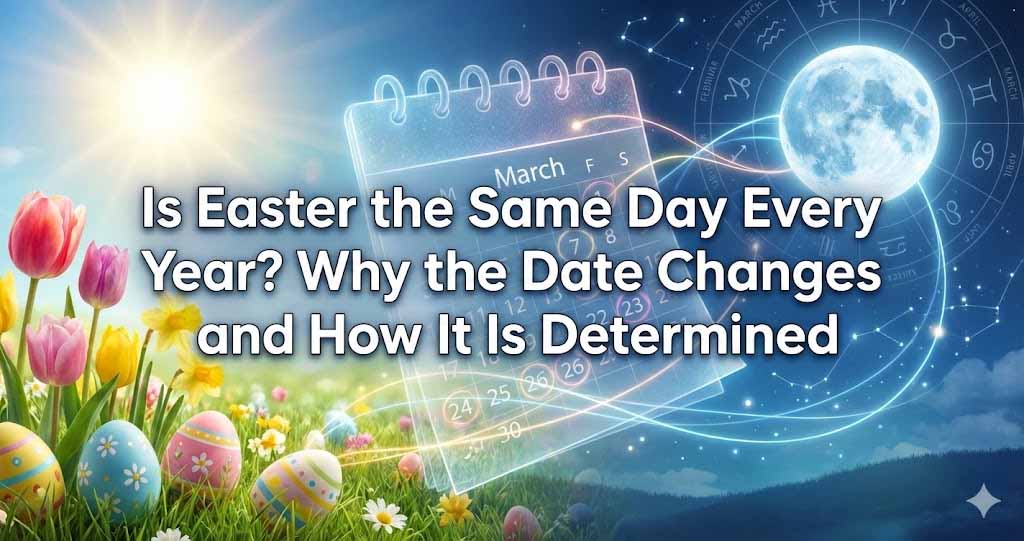
Is easter the same day every year? The short answer is no. Although Easter is always celebrated on a Sunday in the United States, the calendar date changes annually. This movement often leads people to ask what day is easter every year or what day is easter each year as spring approaches. Unlike holidays such as Christmas, which remain fixed to a specific date, Easter follows a calculation system rooted in both astronomical and historical tradition.
Understanding why Easter does not occur on the same date each year requires looking at how the holiday is calculated. The answer connects directly to when is easter day and how is easter day determined under the Western Christian calendar used throughout the United States.

Is Easter the Same Day Every Year?
No, Easter is not the same calendar date every year. While it always falls on a Sunday, the numerical date shifts between late March and late April. This variability reflects the method used to calculate the holiday rather than any random change in scheduling.
Why Easter Is Always on a Sunday
Easter’s consistent placement on Sunday is rooted in Christian belief. According to the New Testament, Jesus rose from the dead on the first day of the week, which is Sunday. Because of this theological foundation, Easter is permanently anchored to Sunday observance.
This means that although the calendar date changes, the weekday does not. When people ask is easter the same day every year, they are usually referring to the numerical date rather than the day of the week.
Why the Calendar Date Changes Each Year
The shifting date of Easter is not arbitrary. It is determined by a specific formula that combines the spring equinox with the lunar cycle. Because lunar phases do not align perfectly with the Gregorian calendar, the resulting Easter date moves each year.
This structure ensures that Easter can fall anywhere between March 22 and April 25. As a result, anyone searching what day is easter every year must check the calculated date for that specific year.
What Day Is Easter Every Year?
The question what day is easter every year does not have a single calendar answer. Instead, Easter occurs on the first Sunday after the first full moon that falls on or after March 21. This rule ensures that Easter is always celebrated in spring but prevents it from being tied to a fixed date.
The Official Date Range for Easter
Under the Western Christian calculation, Easter can fall on any Sunday between March 22 and April 25. These boundary dates represent the earliest and latest possible occurrences.
Most Easter Sundays fall somewhere in early to mid-April, but rare configurations of the lunar cycle can push the holiday toward either extreme of the range.
Examples From Recent Years
Looking at recent years demonstrates the pattern clearly. Some years place Easter in late March, while others position it in mid-April. These differences often affect school schedules, travel plans, and seasonal events across the United States.
Because of this variability, it is common for Americans to confirm when is easter day at the beginning of each calendar year rather than relying on memory.
How Is Easter Day Determined?
To fully understand why Easter is not the same date every year, it is necessary to examine how is easter day determined. The calculation method was standardized in the fourth century and remains the basis for Western Christian observance today.
The Role of the Spring Equinox
For ecclesiastical purposes, the spring equinox is fixed at March 21. Although the astronomical equinox can vary slightly, the church calculation uses March 21 as a constant reference point.
Once March 21 has passed, the next full moon becomes the key marker. Easter is not determined by the equinox alone but by what follows it in the lunar cycle.
The First Sunday After the Full Moon
Easter is celebrated on the first Sunday after the first full moon that occurs on or after March 21. If the full moon falls on a Sunday, Easter is observed the following Sunday instead.
This rule explains the movement of Easter within its 35-day range. Because the full moon does not occur on the same civil calendar date every year, Easter’s calendar date also shifts.
Why Easter Is Called a Movable Feast
In liturgical terminology, Easter is classified as a movable feast. This term refers to religious observances that do not occur on a fixed calendar date but instead follow a calculation or pattern.
Difference Between Movable and Fixed Feasts
Fixed feasts, such as Christmas on December 25, occur on the same date every year. Movable feasts, like Easter, shift because they depend on astronomical or lunar cycles.
The distinction clarifies why asking is easter the same day every year yields a different type of answer than asking about fixed-date holidays.
Historical Origins of the Calculation
The Council of Nicaea in 325 AD established a uniform method for determining Easter. Prior to this council, different Christian communities observed Easter on varying dates.
By linking Easter to the first Sunday after the first full moon following March 21, church leaders created a standardized system that continues to guide observance today.
How Easter’s Changing Date Affects the Religious Calendar
Easter does not exist in isolation. It anchors the entire Christian liturgical calendar. Once the Easter date is determined, other observances are calculated relative to it.
Lent and Ash Wednesday
Ash Wednesday occurs 46 days before Easter Sunday. Because Easter moves each year, Ash Wednesday also shifts annually.
This relationship demonstrates why understanding when is easter day is essential for mapping the full Lenten season.
Holy Week and Good Friday
Holy Week includes Palm Sunday, Maundy Thursday, and Good Friday, all leading up to Easter Sunday. The placement of these observances changes in direct response to Easter’s calculated date.
As a result, confirming what day is easter each year allows churches and communities to coordinate the full sequence of events accurately.
Why Easter Does Not Have a Fixed Date Like Christmas
Many people compare Easter to Christmas and wonder why one holiday remains fixed while the other changes every year. Christmas is celebrated on December 25 regardless of the day of the week. Easter, however, follows a calculation that ties it to both the spring season and the lunar calendar.
This distinction explains why asking is easter the same day every year produces a different answer than asking about other widely observed holidays. Easter’s timing reflects early Christian efforts to preserve theological symbolism rather than align with a fixed civil date.
The Connection to Passover
Historically, the timing of Easter was linked to the Jewish Passover, which is itself based on a lunar calendar. Because Passover does not occur on a fixed Gregorian calendar date, Easter inherited this variability.
By maintaining a relationship to the lunar cycle, early Christian leaders ensured that Easter retained its connection to the broader historical narrative of the crucifixion and resurrection.
The Influence of the Lunar-Solar Calendar
The Gregorian calendar is solar-based, while lunar months follow a 29.5-day cycle. Because these systems do not align perfectly, full moons shift relative to the civil calendar each year.
As a result, the Sunday following the relevant full moon also shifts. This is the fundamental reason Easter does not occur on the same calendar date annually.
How Often Does Easter Fall on the Same Date?
Although Easter moves each year, patterns do repeat over long periods. The calculation follows a 19-year lunar cycle known as the Metonic cycle. After 19 years, the lunar phases realign closely with the solar calendar.
The 19-Year Cycle Explained
The Metonic cycle allows the church calendar to approximate the alignment between lunar months and solar years. While not perfectly exact, it creates recurring date patterns over time.
However, even within this cycle, Easter does not fall on the same date every consecutive year. It may repeat a date decades later but not in a simple annual sequence.

Rare Early and Late Easters
Certain Easter dates, such as March 22 or April 25, occur infrequently. When these rare dates appear, public interest in what day is easter every year tends to increase.
These edge cases highlight the full flexibility of the calculation system.
How Easter’s Changing Date Affects Civil Life in the United States
Beyond religious observance, Easter’s shifting date influences many aspects of civil life. Schools, businesses, and local governments often coordinate schedules around Easter weekend.
Spring Break Variability
In some years, spring break coincides with Easter. In other years, the two occur weeks apart. Because Easter can fall anywhere from late March to late April, the overlap with school vacations changes annually.
This variability reinforces why Americans verify when is easter day at the beginning of each year.
Travel and Economic Activity
Easter weekend often generates increased travel and retail activity. Families gather for meals and church services, and many communities host seasonal events.
Businesses rely on accurate calendar forecasting, which depends on understanding how is easter day determined and when it will occur in a given year.
Common Misconceptions About Easter’s Date
Despite the established calculation rule, misconceptions about Easter’s date remain common. Some believe it is tied to a specific Sunday in April, while others assume it rotates on a simple pattern.
Myth: Easter Is the Second Sunday in April
One widespread misconception is that Easter always falls on the second Sunday in April. While this sometimes happens, it is purely coincidental and not part of the calculation rule.
Because the date is tied to the full moon after March 21, it can occur in late March or late April as well.
Myth: The Date Is Random
Another misconception is that Easter’s date changes randomly. In reality, the system is precise and consistent, even though it may appear unpredictable without understanding the formula.
The combination of the equinox and the lunar phase creates a structured, repeatable method rather than arbitrary movement.
Why Understanding Easter’s Date Still Matters Today
Even in a modern secular society, Easter remains one of the most widely observed religious holidays in the United States. Its timing affects religious institutions, families, and community planning across the country.
Religious Observance
Churches plan extensive programming around Easter Sunday, including special services, music, and outreach events. Confirming the date well in advance is essential for logistical preparation.
The broader question of is easter the same day every year often emerges during this planning process.
Cultural and Family Traditions
For many families, Easter marks an important annual gathering. Even those who do not participate in formal religious observance often celebrate through shared meals or seasonal traditions.
Knowing what day is easter each year ensures that families can coordinate schedules effectively.
Frequently Asked Questions About Is Easter the Same Day Every Year
Is Easter the same day every year?
No. Easter always falls on a Sunday, but the calendar date changes annually within the range of March 22 to April 25.
What day is Easter every year?
Easter is celebrated on the first Sunday after the first full moon occurring on or after March 21.
How is Easter day determined?
Easter is determined by a formula established in the fourth century that links the holiday to the spring equinox and the lunar cycle.
When is Easter day?
The date varies each year and must be calculated using the established ecclesiastical rule.
Can Easter fall in March?
Yes. Easter can fall in March if the full moon after March 21 occurs early enough to place the following Sunday within that month.