
No products in the cart.

Easter Gift Ideas
Why Is Easter on Different Days? Why the Date Changes Every Year
24
Feb
Feb
Why is easter on different days every year? This recurring question appears each spring in the United States because Easter does not follow a fixed calendar date like many other widely observed holidays. Unlike celebrations that are permanently tied to a specific day of the month, Easter moves between late March and late April depending on a calculation system established centuries ago. For many Americans, the changing date creates confusion and curiosity, especially when trying to coordinate travel plans, religious services, or school schedules. To understand why does easter day change, it is necessary to explore both the astronomical foundations and the historical decisions that shaped the modern rule. The explanation is closely connected to how is easter day determined and clarifies why checking when is easter day each year remains essential.
Why Is Easter on Different Days Every Year?
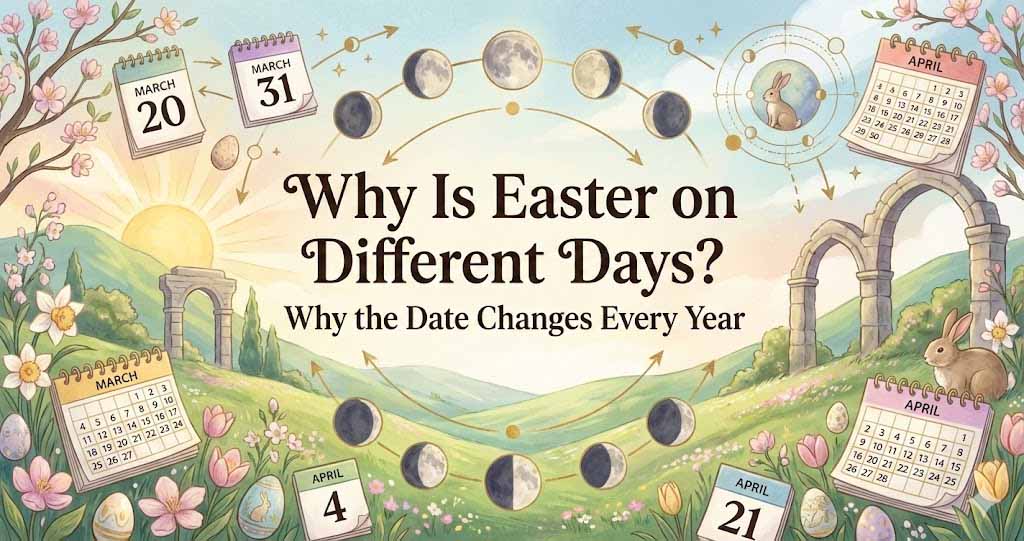
The primary reason Easter falls on different days each year is that it is determined by a formula rather than a fixed position in the Gregorian calendar. Specifically, Easter is celebrated on the first Sunday after the first full moon that occurs on or after March 21. Because the lunar cycle does not align perfectly with the solar year, the date of that full moon shifts annually. When the full moon occurs shortly after March 21, Easter may fall in late March. When it occurs later in April, Easter moves accordingly. This dynamic interaction between the equinox and the lunar phase is the core reason why is easter on different days from one year to the next.

The Role of the Spring Equinox
The calculation begins with the spring equinox, which marks the seasonal transition from winter to spring in the Northern Hemisphere. For ecclesiastical purposes, the equinox is fixed at March 21, even though the astronomical equinox may occur on slightly different dates in some years. By using March 21 as a consistent reference point, the church ensured that Easter would always occur during the spring season. This seasonal anchor preserves the symbolic association of Easter with renewal and new life while also providing a stable starting point for the calculation. Without this fixed equinox reference, determining why does easter day change would be far more complex and potentially inconsistent across regions.
The Influence of the Lunar Cycle
After establishing March 21 as the starting reference, the calculation turns to the moon. The moon completes a full cycle approximately every 29.5 days, meaning that the date of the full moon shifts each month relative to the civil calendar. Easter depends on identifying the first full moon that occurs on or after March 21. Because that full moon does not fall on the same calendar date every year, the Sunday that follows it also varies. This variability in the lunar cycle explains the shifting nature of Easter and directly answers the question of why is easter always on a different day. The moon’s movement, rather than the civil calendar alone, governs the timing of the holiday.
The Requirement That Easter Fall on a Sunday
In addition to the equinox and full moon requirements, Easter must always be celebrated on a Sunday. This rule reflects the belief that the resurrection of Jesus occurred on the first day of the week. As a result, the calculation does not simply identify the full moon date itself but instead selects the first Sunday following that full moon. If the full moon happens to occur on a Sunday, Easter is postponed to the following Sunday to maintain the sequence. This additional requirement adds another layer of variability, further clarifying why is easter on different days every year despite following a consistent calculation formula.
Why Does Easter Day Change Instead of Staying Fixed?
Many people assume that holidays change only because of modern scheduling decisions, but Easter’s variability is rooted in theological and historical considerations rather than convenience. When early Christian leaders formalized the rule for Easter, they chose to connect it to both the spring equinox and the lunar cycle rather than assign it a permanent date. This decision ensured that Easter would remain symbolically linked to the season of renewal and to the Jewish Passover, which itself follows a lunar calendar. As a result, the holiday was structured as a movable observance from the beginning. Understanding why does easter day change therefore requires looking at the origins of the rule rather than assuming the date could simply be fixed by decree.
The Historical Connection to Passover
The timing of Easter has historical ties to the Jewish Passover, which commemorates events described in the Hebrew Scriptures and is determined according to a lunar calendar. Because the crucifixion and resurrection narratives are historically associated with the Passover period, early Christians sought to preserve that seasonal connection. However, disagreements arose regarding whether Easter should always coincide directly with Passover or instead be observed on a Sunday. The eventual compromise retained the lunar framework while mandating Sunday observance. This historical compromise is a central reason why is easter always on a different day within the civil calendar while still following a consistent rule.
The Council of Nicaea and Standardization
In 325 AD, the Council of Nicaea played a decisive role in standardizing the method used to calculate Easter. Before this council, regional variations led to disagreements about the proper date. The council affirmed that Easter should be celebrated on the first Sunday after the first full moon following the spring equinox. This standardized rule provided unity across Christian communities and remains the foundation for how is easter day determined today. The enduring nature of this decision explains why the date continues to shift annually yet follows a predictable structure.
Why Is Easter Always on a Different Day Compared to Fixed Holidays?
Easter differs from holidays such as Christmas or Independence Day because it is classified as a movable feast. Fixed holidays remain tied to specific calendar dates, while movable feasts depend on calculations involving seasonal or lunar markers. The choice to make Easter movable was intentional, preserving its symbolic and historical associations rather than aligning it with the civil calendar for convenience. This distinction clarifies why is easter on different days every year and highlights the unique place Easter occupies within both religious and cultural traditions in the United States.
How the Changing Easter Date Creates a 35-Day Range
One of the most noticeable consequences of the calculation rule is that Easter can fall within a 35-day window, from March 22 to April 25. This broad range often surprises people who assume the holiday stays within a narrower part of April. The reason for this span lies in the timing of the first full moon after March 21. If that full moon occurs on March 21 or March 22 and the following Sunday comes immediately afterward, Easter may be celebrated very early in the season. Conversely, if the relevant full moon does not occur until mid-April, Easter can be pushed toward the end of its possible range. This fluctuation reinforces why is easter on different days and demonstrates that the variability is built directly into the calculation framework.
Early Easter Years
In years when the full moon occurs soon after the fixed equinox date, Easter may fall in late March. Early Easters are less common than mid-April occurrences, but they remain entirely consistent with the established rule. When this happens, the broader spring season feels shifted, with Lent beginning earlier and post-Easter observances also moving forward. These early placements often prompt renewed interest in why does easter day change, especially among those who associate Easter primarily with April.
Late Easter Years
When the first full moon after March 21 does not occur until mid-April, the subsequent Sunday can fall as late as April 25. In these years, Easter appears noticeably delayed compared to the average. The later timing influences school schedules, seasonal events, and even weather expectations in different parts of the United States. Despite appearing irregular, these late occurrences follow the same precise formula that governs every Easter date.
How the Changing Date Affects Religious and Cultural Life
The variability of Easter extends beyond theological calculation and has tangible effects on American society. Because Easter anchors much of the Christian liturgical calendar, its shifting date alters the timing of Lent, Holy Week, and Pentecost each year. In addition, secular institutions often plan events around Easter weekend, whether directly or indirectly. This broader impact explains why confirming when is easter day remains relevant not only for churches but also for families, schools, and community organizations.
Impact on Lent and Holy Week
Lent begins forty-six days before Easter Sunday, counting both weekdays and Sundays. As Easter shifts, so does the entire Lenten season, including Ash Wednesday and Holy Week observances. In some years, Ash Wednesday occurs in early February; in others, it begins later in the month or even in March. This cascading effect underscores how central Easter is to the liturgical calendar and highlights the importance of understanding how is easter day determined.
Influence on School Calendars and Spring Break
In many regions of the United States, spring break is scheduled near Easter, though not always precisely aligned with it. When Easter falls early, spring break may occur after the holiday; when Easter falls late, spring break may precede it. These scheduling variations can create confusion for families coordinating travel or gatherings. The shifting date therefore has practical implications that extend far beyond theological discussion.
Common Misconceptions About Why Easter Changes
Despite the long-standing nature of the calculation rule, misconceptions persist. Some believe the date changes arbitrarily or is adjusted by modern authorities each year. Others assume Easter simply rotates within April without recognizing the role of the equinox and the lunar cycle. Addressing these misunderstandings is essential to accurately answering why is easter always on a different day.
Myth: The Date Is Random
Easter’s date is not random, nor is it determined by shifting cultural trends or administrative decisions. The formula has remained essentially unchanged for centuries. What may appear unpredictable at first glance is actually the result of consistent astronomical cycles interacting with a fixed ecclesiastical rule. Once the equinox reference date and the lunar requirement are understood, the apparent unpredictability becomes logical.
Myth: Easter Is Always in April
While many Easter celebrations do occur in April, the holiday can fall in March when the relevant full moon occurs shortly after March 21. This fact often surprises those who assume April is the default month for Easter. Recognizing the full 35-day range helps clarify why is easter on different days and dispels the misconception that the holiday is confined to a single portion of the spring season.
The Ongoing Relevance of Understanding Why Easter Changes
Although the Easter calculation originated in late antiquity, it continues to influence modern religious and cultural life. Churches publish Easter dates decades in advance using established tables, yet public interest in why does easter day change remains strong. Each year, search queries increase as Americans verify the date for planning purposes. The enduring curiosity reflects the unique character of Easter as a movable feast that bridges ancient astronomical knowledge and contemporary calendar usage.
Educational Value of the Calculation
Understanding why is easter on different days provides insight into the broader relationship between science and tradition. The calculation illustrates how early Christian communities integrated astronomical observations into their liturgical structure. Rather than rejecting natural cycles, they incorporated them into a theological framework that has endured for centuries. This synthesis of seasonal awareness and spiritual symbolism gives Easter its distinctive place among global observances.
Why the Rule Is Unlikely to Change
From time to time, proposals emerge suggesting that Easter should be assigned a fixed date for convenience. However, such proposals have not gained lasting traction. The existing rule carries deep historical and theological significance, and altering it would require broad international consensus across multiple Christian traditions. As a result, the movable nature of Easter is likely to remain a defining feature of the holiday for the foreseeable future.
Frequently Asked Questions About Why Easter Is on Different Days
Why is Easter on different days each year?
Easter falls on different days because it is celebrated on the first Sunday after the first full moon that occurs on or after March 21, causing the calendar date to shift annually.
Why does Easter day change instead of staying fixed?
Easter changes because it was intentionally structured as a movable feast tied to the spring equinox and lunar cycle rather than assigned a permanent date in the civil calendar.
Why is Easter always on a different day compared to Christmas?
Christmas is a fixed-date holiday celebrated on December 25, while Easter depends on a calculation involving both seasonal and lunar markers, resulting in annual variation.
When is Easter day?
Easter can occur on any Sunday between March 22 and April 25, depending on the timing of the first full moon after March 21.